I've been looking at a lot of PT clinic websites lately. Fifty of them, to be exact.
Most look fine on the surface. Professional design, decent photos, all the standard pages you'd expect. Nothing obviously broken.
But here's the problem: they're not converting. Patients are landing on these sites and leaving without booking. And after auditing 50+ cash-based PT websites, I found that only about 25% pass what I call the 3-Second Test.
The other 75%? They're leaking patients before anyone scrolls past the first screen.
What Is the 3-Second Test?
The test is simple. Here's how it works:
Have someone who's never seen your website open it on their phone. Give them exactly three seconds to look at it. Then have them close the browser or look away.
Now ask them two questions:
- What does this clinic specialize in?
- If you wanted to take the next step, what would you do?
That's it. Two questions.
What passing looks like:
- "They specialize in vestibular therapy for people with dizziness."
- "I'd click the 'Book a Free Discovery Call' button in the top right."
Clear. Confident. No hesitation.
What failing looks like:
- "Um... physical therapy? General rehab maybe?"
- "I'd probably look around for a contact page somewhere."
Vague. Uncertain. Already half-checked-out.
Here's the thing: both questions need clear, confident answers. One out of two isn't passing. If a visitor knows what you do but can't figure out how to take action, you've lost them. If they see a clear button but have no idea whether you can help their specific problem, you've also lost them.
Both pieces have to land. In three seconds.
Why Three Seconds?
This isn't an arbitrary number I made up. The research on first impressions is pretty brutal.
Studies show users form an initial impression of a website in as little as 50 milliseconds. That's 0.05 seconds—faster than you can blink. And 94% of those first impressions are design-related. Not what the site says. What it looks like.
But here's where it gets practical: while that gut reaction happens almost instantly, users typically give your homepage about 3 to 5 seconds to earn their trust before deciding to stay or leave. Research from Hotjar found that 64% of consumers decide whether a website has what they need within just a few seconds.
What does this mean for your website?
Visitors aren't reading your homepage. They're scanning.
They're not consciously evaluating your credentials or carefully considering your services. They're getting a feeling. And that feeling forms before they've processed a single sentence of your carefully written copy.
This matters even more for cash-based PT.
You're asking someone to pay out of pocket—often $150+ per session. They'll only do that if they believe the care they'll get from you is significantly better than what they'd get at the insurance-based clinic down the street.
That belief has to start forming immediately.
"We treat all conditions!" doesn't trigger that belief. Specialization does. Clarity does. A visitor thinking "these people focus on exactly my problem" does.
Question 1: Do I Immediately Know What This Clinic Specializes In?
When someone lands on your site, they need to know three things almost instantly:
- Does this clinic treat my specific condition?
- Are they specialists or generalists?
- Am I in the right place?
What I see on sites that pass:
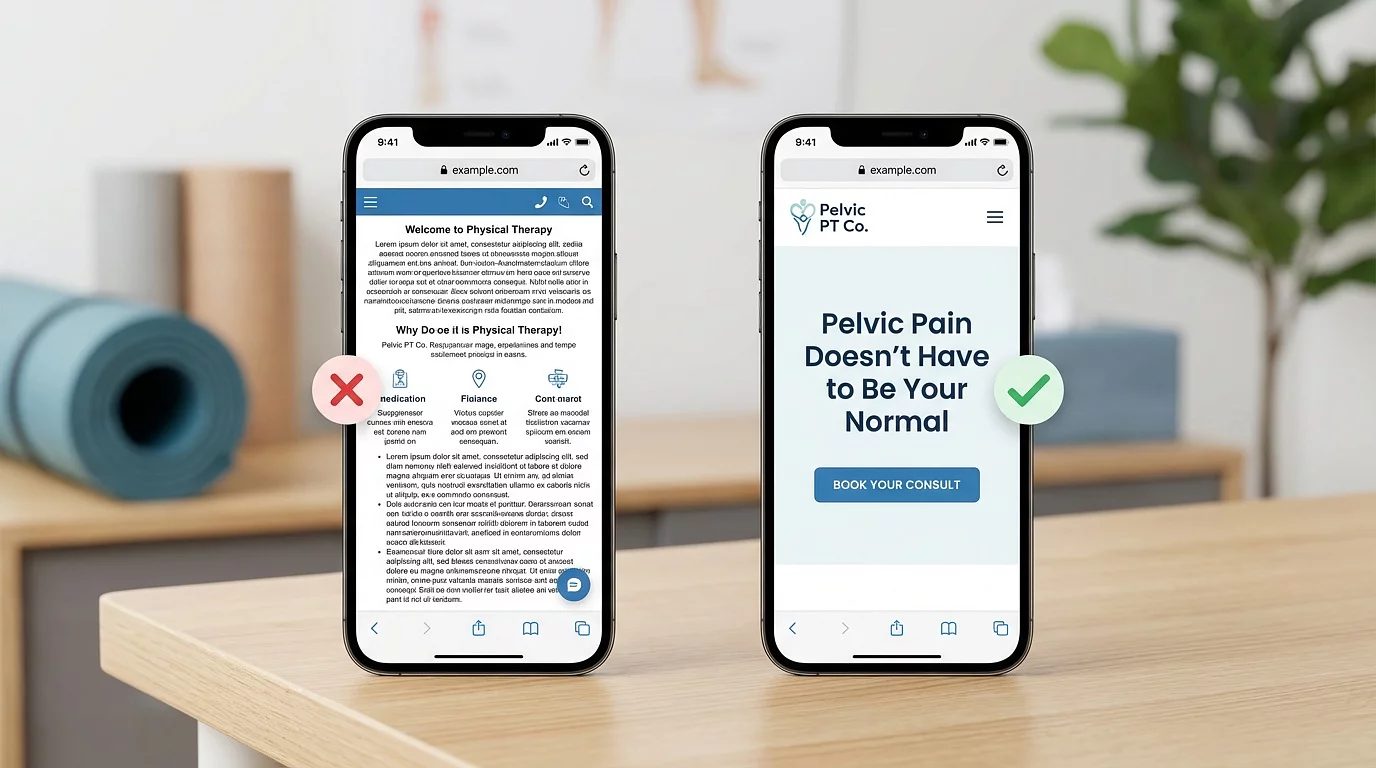
The hero section—that first screen a visitor sees—speaks directly to a specific condition or patient type. No ambiguity.
- "Vestibular Specialists Helping You Get Rid of Dizziness for Good"
- "Pelvic Floor Physical Therapy for Women in [City]"
- "Sports Injury Rehab for Athletes Who Want to Get Back in the Game"
The specialty is impossible to miss. Within three seconds, a visitor with that condition knows: "This is for me."
What I see on sites that fail:
One pattern I see constantly: a hero image with no text at all. Just a calming photo—maybe someone doing a yoga pose with the sun in the background. Pleasant? Sure. But it tells the visitor nothing about what you actually do or who you help.
Other common failures:
- Generic headlines like "Compassionate Care" or "Your Recovery Starts Here" or "Welcome to Our Practice"
- Trying to appeal to everyone, which ends up appealing to no one
- The specialty is mentioned, but it's buried on an interior page—requiring clicks to discover
The test within the test:
If someone with chronic dizziness lands on your vestibular PT website, do they immediately think "YES, this is exactly what I've been looking for"?
Or do they think "Hmm, maybe? Let me dig around and see if they actually treat my thing..."
That moment of hesitation? That's a lost patient. They're already one click away from checking out a competitor who made it immediately obvious.
Question 2: Do I Know Exactly What to Do Next?
The second half of the test is about action. Once a visitor decides you might be able to help, they need to know what to do next. And it needs to be obvious.
What the visitor needs to see:
- One clear action to take
- A button, not a text link
- Language that tells them what happens when they click
What I see on sites that pass:
The primary CTA sits in the header as a contrasting button—not styled like the other navigation links. It's usually on the far right, visually separated from everything else. Hard to miss.
That same CTA appears again in the hero section. Repetition isn't redundant here; it's clarity.
The language is specific: "Book Your Free Discovery Call" or "Schedule Your Assessment." The visitor knows exactly what happens when they click.
What I see on sites that fail:
The most common issue: there's no CTA in the header at all. Or if there is one, it's a black text link that looks identical to "About" and "Services" and "Blog." It blends in completely.
Another pattern I see constantly: a "Contact Us" link buried between five other navigation items, styled exactly the same as everything else. The visitor has to hunt for it.
And then there's the language problem. "Contact Us" is vague. Contact you how? For what? What happens after I fill out the form? Compare that to "Book Your Free Discovery Call"—which tells me exactly what I'm getting.
Some sites have the opposite problem: too many CTAs. Six different buttons, all competing for attention. Schedule here, call us, download this, sign up for that, check out our programs. When everything is a priority, nothing is.
The hierarchy that works:
- One primary CTA (typically a booking or discovery call link)
- Maximum one secondary CTA (your phone number, or a lead magnet like "Take Our Pelvic Floor Assessment Quiz")
- Everything else gets out of the way
If you're not sure what your primary CTA should actually lead to—what offer you're making to prospective patients—that's a deeper issue worth sorting out. Having a clear offer makes your CTA infinitely more compelling.
How to Run This Test on Your Own Site
Here's the DIY version you can run this week:
Step 1: Find someone who's never seen your website. This could be a spouse, a friend, someone from a PT Facebook group—anyone who isn't already familiar with your clinic.
Step 2: Send them your URL.
Step 3: Tell them: "Open this on your phone. Look at it for three seconds, then close it or look away."
Step 4: Ask the two questions:
- What does this clinic specialize in?
- What would you do if you wanted to learn more or book an appointment?
Step 5: Listen. Don't prompt them or help them along. Hesitation or vagueness = fail.
What to do with the results:
- Pass both: Your foundation is solid. The basics are working.
- Fail Question 1: Your hero section needs work—the headline, the imagery, how you're positioning your specialty.
- Fail Question 2: Your CTA needs work—visibility, placement, or the copy itself.
- Fail both: You have a conversion problem that's actively costing you patients.
Run it multiple times. Different people notice different things. Three tests will give you a much clearer picture than one.
The Bottom Line
75% of the PT clinic websites I've audited fail the 3-Second Test.
Not because they're ugly. Many of them look perfectly professional.
They fail because they're not immediately clear about two things: what they specialize in, and what the visitor should do next. Both pieces have to land in three seconds. Miss either one, and you're losing patients before they ever scroll.
The good news? These aren't complicated fixes. They don't require a full redesign. But they do require looking at your site the way a first-time visitor sees it—which is harder than it sounds when you've been staring at the same homepage for months.
Want to know how your site stacks up?
We offer a free website audit where we'll run through the 3-Second Test on your site and give you specific feedback on what's working and what's costing you patients. No pitch, no obligation—just an honest look at your site from someone who's reviewed 50+ PT clinic websites and knows what actually converts.