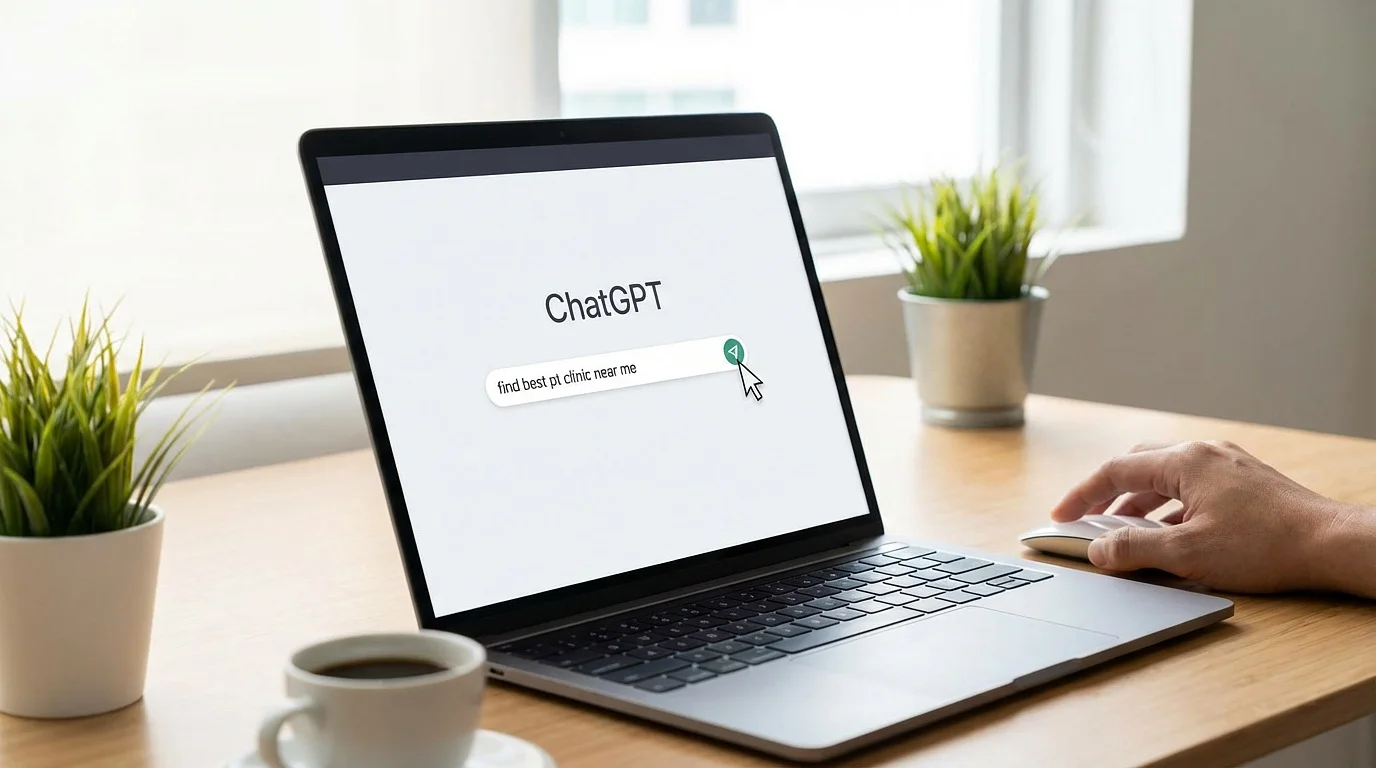
If you've noticed patients mentioning they "asked ChatGPT" for a physical therapist recommendation, you're seeing the biggest shift in how people find healthcare providers since Google Maps. Answer Engine Optimization (AEO) is how you make sure your practice shows up when potential patients ask AI tools for help—and if you're not thinking about this yet, your competitors will be soon.
Here's what you need to know about AEO, why it matters for your PT practice, and what you can do about it this week.
What Is Answer Engine Optimization (AEO)?
Answer Engine Optimization is the practice of structuring your online presence so AI-powered tools—ChatGPT, Perplexity, Google's AI Overviews, Claude—can find, understand, and recommend your practice.
You might also hear this called Generative Engine Optimization (GEO). Same concept, different name. The industry hasn't settled on one term yet, but AEO is more precise because these tools are specifically designed to answer questions.
Here's the key insight: when someone asks ChatGPT "What's the best physical therapy clinic for shoulder pain in [your city]?", the AI doesn't just show a list of links. It synthesizes information from across the web and gives a direct recommendation. If your practice isn't structured to be understood and cited by these tools, you're invisible to a growing segment of potential patients.
This represents the second biggest change in search behavior since Google's algorithm updates ended the era of keyword stuffing. The difference? This time, early movers can win immediately.
Why Should PT Practice Owners Care?
Let's talk numbers.
Companies optimizing for AI search are seeing 6x higher conversion rates from LLM-referred traffic compared to traditional Google search. Some are already getting 8% of their new business from AI recommendations.
Why such high conversion? When ChatGPT recommends your practice, it's not just listing you—it's endorsing you within the context of that person's specific question. That carries more weight than showing up in a list of ten blue links.
The other reason to pay attention: unlike traditional SEO where established practices dominate and newcomers struggle to break through, AEO rewards whoever shows up first with the right information. A solo practice with well-structured content can outperform a large clinic with a generic website.
The patients asking AI for recommendations skew younger and more tech-forward—exactly the demographic that's hardest to reach through traditional marketing. They're also the ones who'll be referring their parents and friends in a few years.
How AEO Differs from Traditional SEO
If you've invested in SEO before, some principles carry over. But there are critical differences.
Probabilistic vs. Deterministic Results
In Google, you either rank #3 for a keyword or you don't. It's binary. In AI search, your practice might appear in 70% of relevant queries, 30%, or not at all—and it varies each time someone asks. You're optimizing for frequency of mention, not a fixed ranking position.
Citations Beat Rankings
In traditional SEO, the #1 result gets the most clicks. In AI search, the AI summarizes information from multiple sources. Being mentioned in three different places the AI pulls from matters more than being the top result in one. This is why third-party mentions (reviews, directories, local news) become even more valuable.
Long-Tail Questions Are Back
Google searches average about 6 words. AI prompts average 25 words. People ask things like "What should I look for in a physical therapist if I have a torn rotator cuff and my insurance is Blue Cross?"
These hyper-specific questions were too niche for traditional SEO. In AEO, they're opportunities. If you're the only practice with content answering that exact question, you win by default.
What You Need to Do for AEO
Here's where this gets practical.
1. Structure Your Content for AI Consumption
AI tools need to quickly understand what your page is about and extract relevant information. This means:
Direct answers to questions in your content (not buried in the fourth paragraph)
FAQ sections on key pages—these are goldmines for AI extraction
Clear headings that match how patients actually ask questions
Data and specifics rather than vague marketing language
Instead of "We provide excellent physical therapy services," write "We specialize in vestibular rehabilitation for vertigo and dizziness, with an average treatment duration of 4-6 sessions."
2. Don't Block AI Bots
This is technical but critical. Check your website's robots.txt file. Many sites accidentally block the crawlers that AI tools use to gather information:
GPTBot (OpenAI/ChatGPT)
PerplexityBot
Google-Extended (for Gemini)
ClaudeBot
If these are blocked, AI tools literally cannot see your website. Ask your web developer to verify this.
Also important: AI bots typically don't run JavaScript. If your site relies heavily on JavaScript to display content, the AI sees a blank page. Server-side rendering matters.
3. Get Mentioned by Authoritative Third Parties
Here's a reality check: only about 10% of AI citations come from a brand's own website. The other 90% come from third-party sources.
For PT practices, this means:
- Google Business Profile (keep it updated with posts, photos, and responses to reviews)
- Health directories like Healthgrades, Zocdoc, WebMD
- Yelp
- Local news mentions or community features
- Professional association listings
When a patient asks ChatGPT for a PT recommendation and it pulls from Yelp reviews mentioning your practice by name, that's AEO working.
4. Answer Specific Patient Questions
Create content that directly answers the questions your front desk hears every day:
"What should I wear to physical therapy?"
"How long does a PT session last?"
"Do I need a referral for physical therapy in [state]?"
"What's the difference between a physical therapist and a chiropractor?"
These aren't high-volume SEO keywords, but they're exactly what people ask AI tools. One well-structured blog post answering a specific question can make you the default citation for that query.
Common Mistakes to Avoid
Self-promotional "best of" lists
If you create a blog post titled "Top 5 Physical Therapy Clinics in [City]" and rank yourself #1, AI tools are increasingly smart enough to down-weight this. They recognize self-promotion and prefer third-party validation.
Ignoring your help content
Your FAQ page and patient resources section might be the most valuable AEO assets you have. Most practices treat these as afterthoughts. In AI search, they're primary sources.
JavaScript-heavy websites
That fancy animated website might look great to humans, but if the content isn't in the initial HTML that loads, AI bots see nothing. Form over function costs you visibility.
Blocking AI crawlers "for privacy"
Some practice owners hear "AI is scraping websites" and panic. Here's the reality: if you block AI crawlers, you're not protecting anything—you're just making yourself invisible while competitors show up. The game is being played whether you participate or not.
Getting Started This Week
You don't need a complete website overhaul. Start here:
Today:
- Ask your web developer to check robots.txt and confirm AI bots aren't blocked
- Verify your Google Business Profile is current (hours, services, photos from the last 90 days)
This Week:
- Add FAQ schema to your homepage and top service pages
- Write one blog post directly answering a specific patient question
This Month:
- Audit your third-party listings (Healthgrades, Yelp, local directories)
- Respond to your most recent Google reviews (AI pulls from these)
Ongoing:
- When patients ask questions, write them down. Each one is potential content.
- Monitor how AI tools respond to queries about your specialty and location
The Opportunity
AEO is early enough that most PT practices haven't heard of it, let alone optimized for it. That's your window.
The practices that structure their content for AI discovery now will have a significant advantage as these tools become the default way younger patients find healthcare providers. And unlike traditional SEO where catching up to established competitors takes years, AEO lets you show up immediately if you have the right information in the right format.
The question isn't whether AI search will matter for patient acquisition. It's whether you'll be visible when it does.