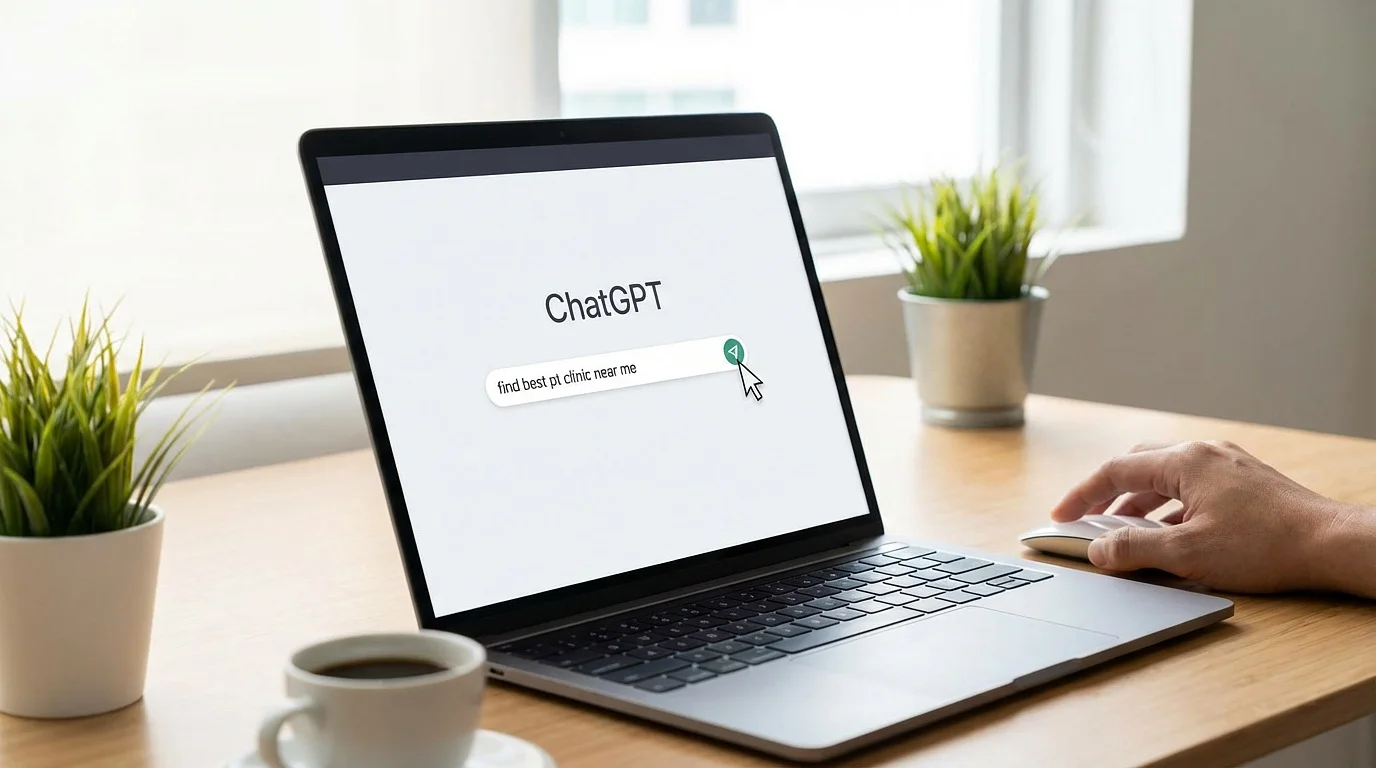
Last week, I asked ChatGPT: "Who's the best physical therapist for vestibular issues near Indianapolis?" It gave me a confident, well-written answer listing four clinics. None of them were the best-known clinic in town. A few of them weren't even the best-ranked on Google.
That's the disconnect no one talks about: only 12% of pages cited by ChatGPT also rank in Google's top 10. You can win on Google and still be invisible to AI. They're different games now — and your next patient is already playing the new one.
If you're a physical therapy practice owner wondering why you're not getting recommended in ChatGPT, Google AI Overviews, or Perplexity, this is the diagnostic and fix-stack we use with our clients at Behind the Practice. Run through it this week.
First: Run the Self-Diagnostic
You can't fix what you haven't measured. Before you change a single thing, establish a baseline.
Pick 5 questions a real patient would ask. For a physical therapy clinic, that looks like:
"Best physical therapist near [your city]"
"Physical therapist for [your specialty] near me"
"Cash-based physical therapy [your city]"
"Best physical therapy clinic for [condition]"
"Top [specialty] physical therapist in [state]"
Ask ChatGPT all five. For each one, note three things: Does your clinic appear? Who does appear? Which sources (sites, directories, articles) get cited in the answer?
Repeat in Google's AI Overview and in Perplexity. Same questions. Record the pattern.
What you're really looking for isn't just "am I there" — it's "who's beating me, and where are they getting their citations from?" That gap tells you everything about what needs to change.
Quick guide: If your clinic appears in 0 of 5 queries, start at Reason #1 below. If you appear in 1–2, skip to Reason #3. If you appear in 3 or more, go straight to "The Monitoring Loop."
The 5 Most Common Reasons PT Clinics Are Invisible in ChatGPT
Every PT clinic we audit falls into at least two of these five categories. They're ranked by how often they're the root cause, not by difficulty.
Reason 1: Your robots.txt Blocks AI Crawlers
This is the single most common reason a PT clinic is invisible in ChatGPT — including for searches of your own brand name.
Why it happens: Most websites were built before GPTBot, ClaudeBot, or PerplexityBot existed. Many website platforms still ship with a default robots.txt that doesn't mention AI crawlers, and a lot of "SEO-optimized" themes actively block them to "conserve crawl budget." If ChatGPT can't read your site, you cannot be cited. Full stop.
The fix: Add explicit allow rules for every major AI crawler. Edit your robots.txt to include:
User-agent: GPTBot
Allow: /

User-agent: ChatGPT-User
Allow: /

User-agent: ClaudeBot
Allow: /

User-agent: PerplexityBot
Allow: /

User-agent: Google-Extended
Allow: /
Time required: 5 minutes. Leverage: Highest of anything on this list. Do it today.
Reason 2: You Have No Schema Markup — Or the Wrong Kind
You rank well on Google but never appear in AI answers. Why? Because Google figured out what you are through years of link-graph analysis and searcher behavior. ChatGPT doesn't have that luxury — it needs structured data to categorize you correctly.
Why it happens: Most PT clinic sites launch with generic WordPress schema (Article, BlogPosting) and nothing more. Without LocalBusiness, MedicalBusiness, Physician, Service, and FAQPage schema in JSON-LD, ChatGPT has to infer what you are from unstructured HTML. Usually it gives up and cites someone who made the categorization easy. Pages with comprehensive schema markup are cited up to 40% more frequently than pages without it.
The fix: Deploy JSON-LD schema for the following:
Organization (business name, description, contact info, area served)
LocalBusiness + MedicalBusiness (combined — you're both)
Physician for each licensed therapist, with credentials
Service for each offering (vestibular therapy, dry needling, pelvic floor, etc.)
FAQPage on every resource article
Article or BlogPosting with
dateModifiedpopulated on every post
Time required: 1–2 hours with a developer, or zero if you're on a modern PT-focused platform that handles schema automatically.
Reason 3: Your Answers Aren't Written for AI Extraction
You have great content. AI cites competitor blog posts anyway. The culprit is almost always the opening sentence of each section.
Why it happens: Large language models extract the first one or two sentences of each section to decide whether it answers the query. If you open with context — "In today's ever-changing healthcare landscape, many patients are asking..." — the AI moves on to a competitor who led with the actual answer. The target format: direct-answer blocks of 40 to 80 words, starting with a factual statement that includes specifics (location, number, service name, year).
The fix: Rewrite the opening of each H2 heading as a direct answer. Then build the context after. Include at least one specific data point per section — a stat, a year, a quantity, a local reference.
A "before and after" example:
Before: "Vestibular therapy is a broad topic that many practice owners find confusing. In this section, we'll explore..."
After: "Vestibular therapy is a specialized form of physical therapy that treats inner-ear disorders causing dizziness, vertigo, and imbalance. Most patients see meaningful improvement in 6–8 sessions over 4–8 weeks. Cash-pay clinics in Indiana typically charge $120–$180 per session."
The second version gets cited. The first one gets ignored.
Time required: 30–60 minutes per page. Prioritize your top 10 pages by traffic or commercial intent.
Reason 4: Your Third-Party Presence Is Thin
You've done the on-site work but ChatGPT still cites review aggregators and local directories instead of your clinic. That's a signal problem, not a content problem.
Why it happens: AI tools cross-check multiple sources before recommending a local business. A single well-written website isn't enough. Domains with active profiles on review and directory sites — Google Business Profile, Healthgrades, Zocdoc, Yelp, WebMD, local news coverage — have 3x higher citation probability than sites without them. For healthcare specifically, reviews are becoming a first-class ranking signal inside AI search.
The fix: Claim, complete, and stack reviews on every relevant directory:
Google Business Profile — the highest-leverage single property. Complete every field. Post weekly. Stack reviews. (See our guide on how to get Google reviews when your patients value privacy if your specialty makes this hard.)
Healthgrades, Zocdoc — complete profiles, accurate credentials, up-to-date hours
Yelp — even if you don't love the platform, it's often cited
Local news, industry directories — APTA state chapters, condition-specific directories, local "best of" lists
Time required: Ongoing. 6–8 hours of setup work, then 15–30 minutes a week of maintenance.
Reason 5: Your Content Is Stale
You published 20 articles two years ago, nothing since, and you're watching rankings slowly slip. That's a citation velocity problem.
Why it happens: AI weighs momentum, not archive. Content updated within the last 30 days receives 3.2x more citations than older material. The algorithm reads freshness as relevance — a blog that hasn't been touched in 18 months reads as "abandoned," no matter how good the content was originally.
The fix: Two rhythms, both weekly:
Refresh: Update your top 5 articles every month. New intro, refreshed stats, added section, new publish date. Populate
dateModifiedin the schema.Publish: Ship at least two new articles per month targeting specific patient questions. Use the questions you hear most often in intake calls — those are exact-match queries in AI search.
Time required: 2–4 hours per week if you're doing it yourself. Far less if you have a marketing partner handling the rhythm.
The Fix Stack: What to Do This Week, This Month, and Ongoing
The order matters. Technical fixes come first — there's no point rewriting content if ChatGPT can't crawl it.
This Week (high-leverage quick wins)
Unblock AI crawlers in robots.txt — 5 minutes. Leverage: ★★★★★
Add LocalBusiness + MedicalBusiness schema — 1 hour. Leverage: ★★★★★
Rewrite the opening paragraph on your top 3 pages — 2 hours. Leverage: ★★★★
This Month (compounding investments)
Add FAQPage schema to every resource article — ~4 hours. Leverage: ★★★★
Claim and complete all directory profiles (GBP, Healthgrades, Zocdoc, Yelp) — ~6 hours. Leverage: ★★★★
Publish 2 new articles on specific patient questions — time varies. Leverage: ★★★
Ongoing (the rhythm that actually moves the needle)
Refresh your top 5 pages monthly — ~2 hours/week. Leverage: ★★★★
Weekly AI citation monitoring (see next section) — time varies. Leverage: ★★★★★
The Monitoring Loop: How to Actually Know It's Working
Here's where most PT clinics fall off — even the ones who did the technical work right.
AI answers are probabilistic. The same query gives different responses on different days. The same question on Monday cites five sources; on Thursday it cites three. You cannot gut-check this. You have to measure it, weekly, over time.
What to track every week:
Citation rate — % of your target queries where your clinic is mentioned at all
Link rate — % of those mentions that include a link back to your site
Competitor map — who's getting cited where you're not, and on which sources they're quoting
Action log — what you changed this week, so you can correlate to movement
Most PT owners spot-check once in a while, then forget. They never see which specific change moved the needle, so the next quarter they guess instead of iterate.
How Behind the Practice Does This for Our Clients
Every BTP client gets a weekly AEO report delivered to their inbox. We track your clinic's citations across Google AI Overviews and ChatGPT for your specific target queries — the same way we track Google rankings. You see:
Which queries cited your clinic this week (and which didn't)
Week-over-week citation trend — are we gaining ground or losing it
Who's beating you, on which sources, and why
The specific actions we took this week to move the needle on your AI visibility
Most PT marketing agencies talk about AEO. We track it every week and show you exactly what we're doing about it. You stop guessing. You start seeing.
→ Book a free strategy call and we'll run a live AI visibility audit on your clinic.
Realistic Timeline: When to Expect Results
Week 1: Technical fixes applied. No visible change yet. Don't panic.
Month 1–2: First AI mentions appear for long-tail, specific queries. Content and GBP investment starts compounding. You're not cited yet, but the signal is there.
Month 2–4: First real AI citations for specific queries — typically long-tail conditions, specialty-plus-city combinations, or niche treatment questions.
Month 6–12: Authoritative citations. You get recommended by name for broader queries. Clinics that started this work in late 2024 are seeing the payoff now in 2026.
Measure in 4-week windows, not days. AI citations lag technical changes by 2–8 weeks. Noise dominates daily numbers. Trend dominates monthly.
The One Question to Ask Yourself
"When a potential patient asks ChatGPT 'best physical therapist near me for [my specialty],' is my clinic in the answer?
If the answer is no, run the diagnostic at the top of this article this week. Every week you wait, the clinic that's doing the work is getting cited instead of you. The AI search era doesn't reward the best clinic — it rewards the clinic that made itself the easiest to recommend.
Ready to See Where You Actually Stand?
If you want to skip the DIY path, we can run the full AI visibility diagnostic on your clinic for free. We'll show you:
The exact queries your ICP is running — and whether you appear in any of them
Which three fixes would move the needle fastest on your specific site
What your weekly AEO report would look like as a Behind the Practice client
Book a free 15-minute discovery call →
Further reading: What Is Answer Engine Optimization? A Guide for PT Practice Owners · What to Look for in a Physical Therapy SEO Company · Google Business Profile for Physical Therapists