
December can get quiet for many cash clinics, which is why it is worth having a few physical therapy marketing ideas ready for it. Your patients travel to see family, cancel their regular sessions, and put their spare money toward gifts instead of their own health. An in-network clinic down the street often sees a big year-end rush from people who finally met their insurance deductible and want to use those visits before the year ends. A cash clinic doesn't get that December rush, but you do get January, when many of those insurance deductibles reset. When a patient has to pay out of pocket anyway, cash care makes a lot more sense, so a good December plan sets up your whole January schedule.
You do not need a complicated calendar of holiday marketing ideas to make December count. Below I will walk through five plays you can set up this week, complete with the pricing math and the rules to check first.
Where do these physical therapy marketing ideas come from?
These plays come from Alex Hormozi, across his books $100M Leads [1] and $100M Money Models [2], his Black Friday episode on The Game podcast [3], and a short video on the gift card play [5]. I didn't invent any of these. What I add is what each one looks like in a PT clinic, and where the rules bite. If you want to read more on why structuring a clear package matters so much before you run a promotion, I wrote a full breakdown on why your PT clinic needs an offer instead of just selling single sessions.
Play 1: How does the gift card play work for a PT clinic?
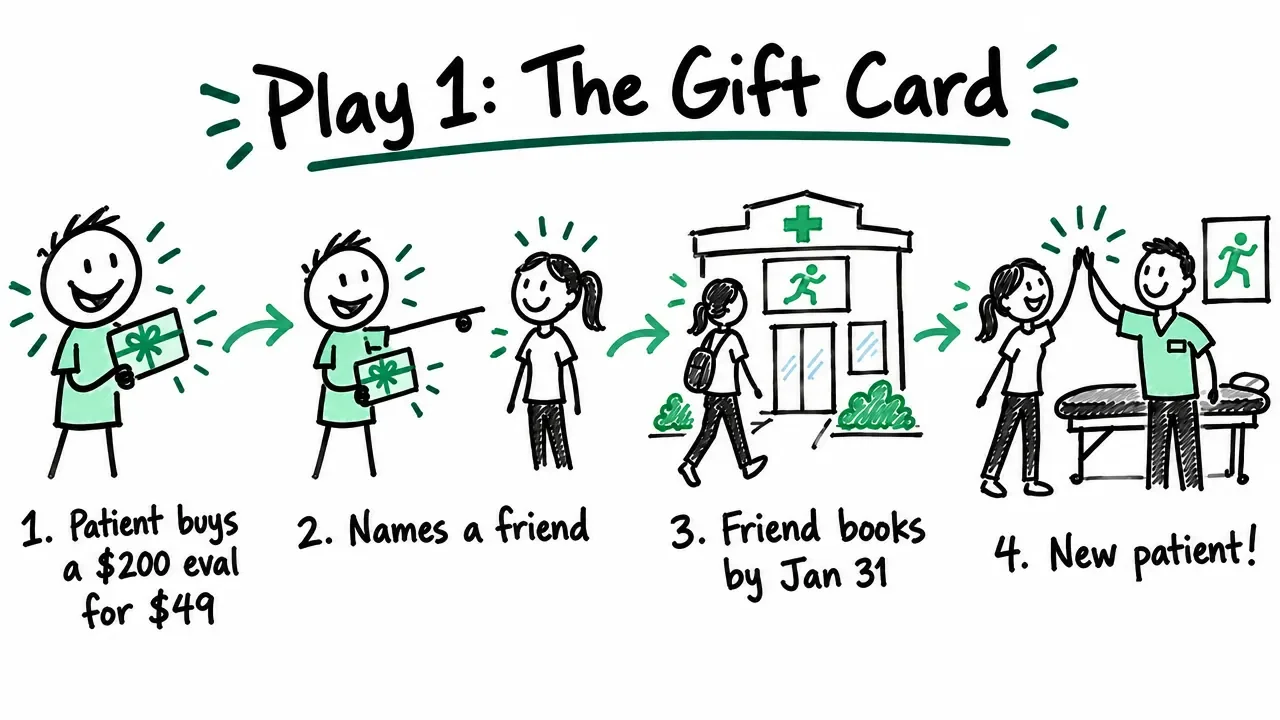
The idea
The idea is to sell a gift card worth about $200 for 90% off and let each customer buy up to 3 of them, with a few rules that keep it from turning into a plain discount:
- The buyer can't use the card on themselves.
- The buyer has to name the person they're giving each card to.
- The card is priced so it gets someone in the door without covering the whole solution.
It works best for a business where a customer is worth about $1,000 to $2,000 over time, since the card only covers the first step and the value comes from everything that happens after it.
What it looks like in a PT clinic
You let your current and past patients buy a full evaluation for a friend or family member for $20 to $50, when the regular value of that evaluation at your clinic is much higher. You limit the offer to 3 cards per buyer, and the buyer has to give you the recipient's name at checkout.
If you do not want to tie the card to an evaluation, you can run a couple of different variants:
- You sell a gift card that acts as credit toward a full plan of care, where paying $50 buys $200 of credit, as long as your plan of care costs at least 4 times that $200 credit.
- You sell a discounted recovery session or dry needling session as the gift, and you run that visit as a clinical screen to see if the person needs a larger plan.
This works because the new patient walks into your clinic through a friend they already trust, which greatly increases the odds that they will sign up for a full plan of care.
To get those friends through the door by January instead of July, you put a short deadline on the promotional value of the card. In one study, more than 30% of people used a gift certificate when it had a 2-week deadline, while under 10% used one with a 2-month deadline [4], so a shorter window helps keep the gift from sitting in a kitchen drawer.
The math
I could not find a published result from a PT clinic, a chiropractic office, or a gym for this exact play, so here is the basic clinic math instead. An unused gift card costs your clinic nothing in clinician time, and your clinic keeps what the buyer paid up front. At $49 a card, the play can make money at every patient lifetime value from $500 up, and if you have open slots sitting empty on your schedule anyway, it can make money even when you sell the card at $20.
Watch out for
Health care comes with real compliance rules that a gym or software company never has to think about, so you have to build a few guardrails into your gift card sale:
- Screen every buyer at purchase and every recipient at booking, because this offer is not valid for patients on Medicare, Medicare Advantage, Medicaid, or TRICARE.
- Keep the entire transaction self-pay only, and never bill a third-party payer for the gift evaluation.
- State gift card laws apply to your clinic. Let the amount the buyer paid ($20 to $49) never expire, and put a printed end date only on the promotional value above that amount.
- Your "$200 value" claim must match the real, regular price people actually pay for an evaluation at your clinic.
- Conduct the evaluation normally by giving the patient a written plan of care and a written price for any later care they need, with no hard close in the room.
- Protect patient privacy under HIPAA by never telling the buyer whether their friend actually booked or showed up for the visit.
- Contact the person who received the card only to deliver the gift and get them scheduled, and do not add them to your marketing list unless they opt in themselves.
Play 2: Can a "Win Your Money Back" challenge fill your January schedule?
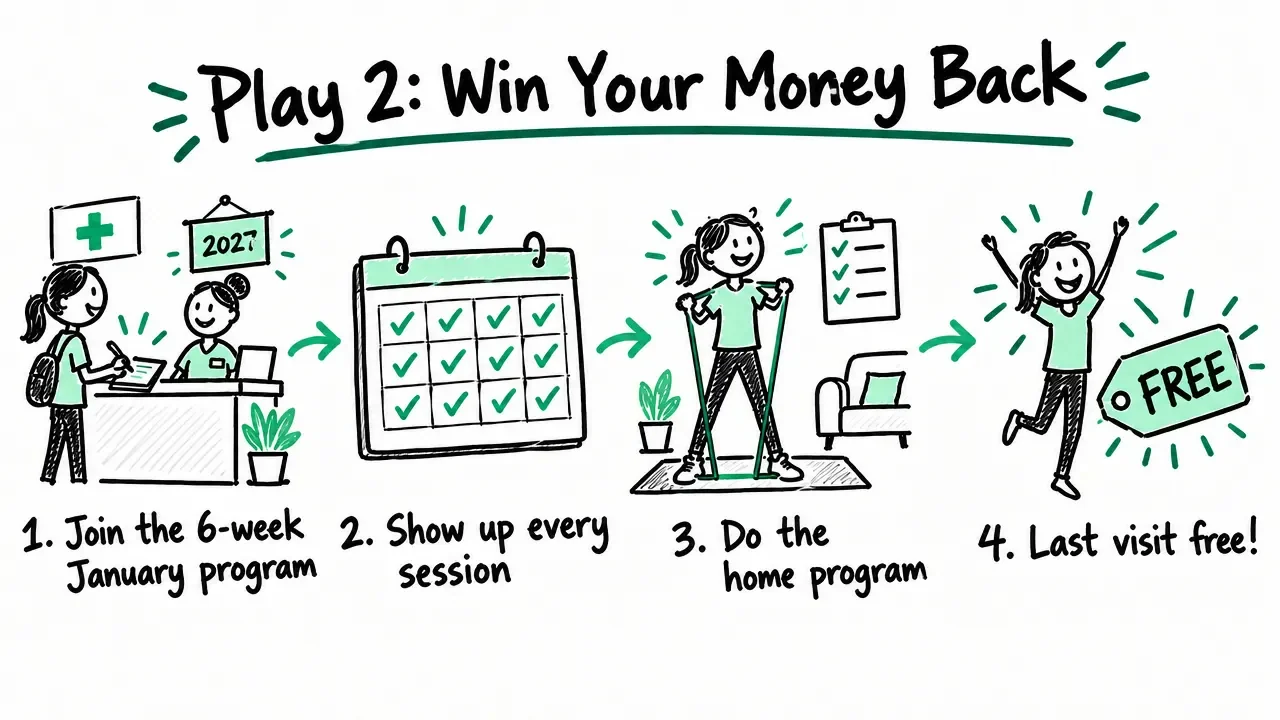
The idea
You give the customer a clear deal up front, where they get back what they paid if they do a specific set of things within a set amount of time and follow the rules you laid out. The reward depends on what the customer actually does, which is in their hands, and you can give the money back as credit toward their next purchase in place of cash.
What it looks like in a PT clinic
In December, you sell a 6-week New Year strength program or a return-to-run program that officially kicks off in January. You give everyone who joins a clear deal up front: come to every scheduled session and log your assigned home program for all 6 weeks, and your last visit is free. You can also structure the reward so the patient gets their program fee back as a clinic credit toward their next block of care.
The math
The condition required to win the credit, showing up to every visit and doing the home exercises, is the same behavior that tends to get a patient results. That is why the patients who earn their money back often become your best case studies.
Watch out for
In marketing for physical therapists, you can never ethically tie a financial reward or a refund to a clinical result or a cure. You must tie the credit strictly to objective attendance and home program completion so you never promise a medical outcome you cannot control.
Play 3: How do you use year-end FSA reminders to reactivate past patients?
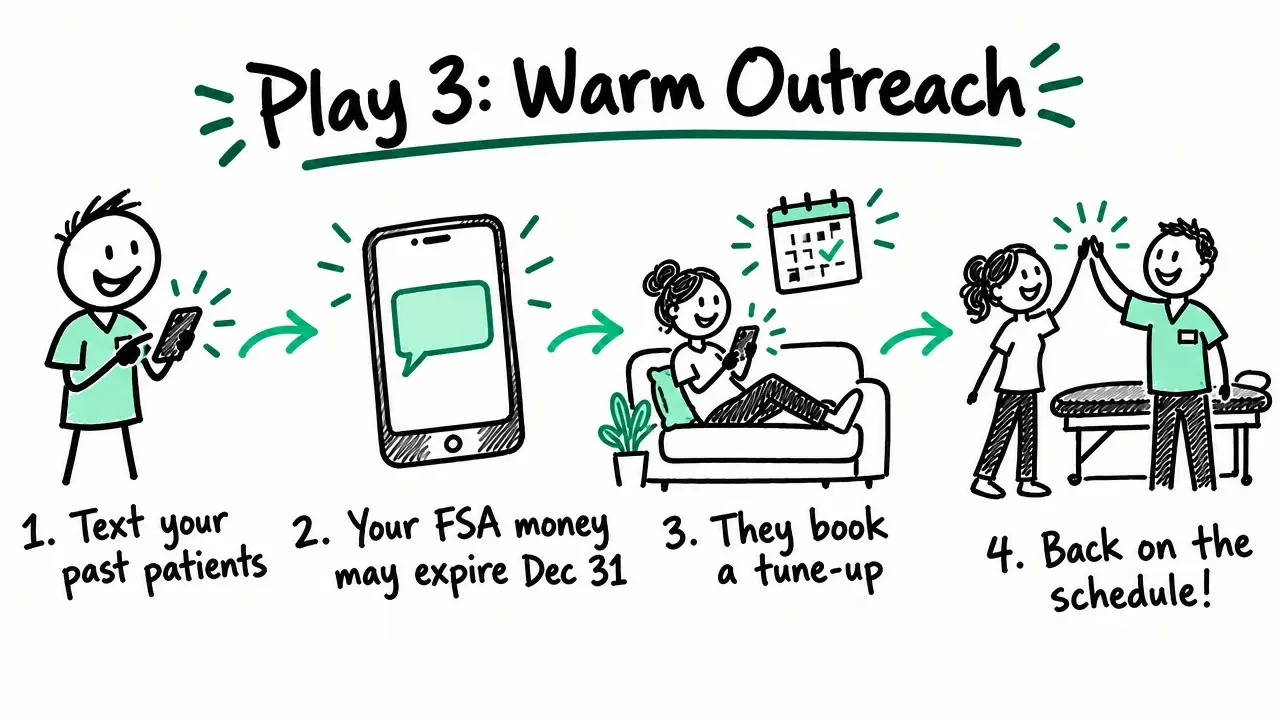
The idea
Your past customers are the cheapest leads you have, since they already know you and trust you, and all they really need from you is a timely reason to come back.
What it looks like in a PT clinic
You send a plain text message and an email to your past patient list in early December with a simple reminder: "Your FSA money may expire on December 31. A tune-up visit is a good use of it." It reads as a helpful reminder, since nobody wants to forfeit their own money back to their employer.
The math
Sending a text or an email to your existing list costs you nothing beyond the software you already pay for. Getting even a handful of past patients to book a single cash tune-up visit can fill the gaps left by holiday cancellations, and it can show you who needs a fresh plan of care in the new year.
Watch out for
Employer FSA rules differ depending on the specific plan, and some plans give employees a grace period or allow a carryover, so you always want to say their funds "may expire" rather than stating it as a certainty. You should also avoid saying that HSA money expires, because it doesn't. Make sure you only send these marketing texts and emails to patients who have opted in to hear from you, and remember that FSA funds only cover visits that actually happen within the current plan year.
Play 4: How does a "Buy X Get Y" offer work with current patients?
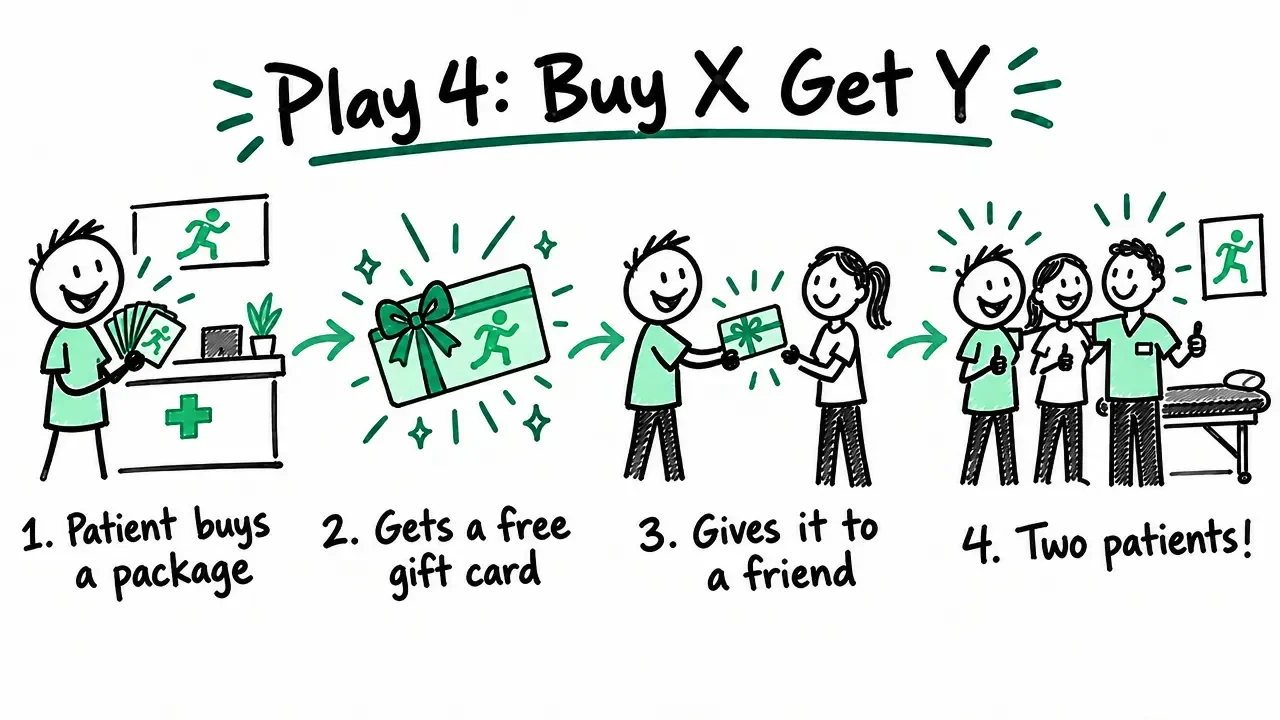
The idea
When a customer buys one thing from you, they get a second, specific thing along with it for free.
What it looks like in a PT clinic
When a current patient buys a package of visits for themselves in December, they get one free gift evaluation certificate to give to a friend or family member. This ties Play 1 directly to the patients who are already buying from you this month, without asking them to spend extra money on the gift.
The math
You secure upfront cash flow from your current patient's package in December, while the bonus certificate can put a warm referral on your calendar for January for the cost of one evaluation.
Watch out for
Whenever you sell a package of visits ahead of time, give the patient clear written terms explaining how their prepaid visits work, how long they have to use the block, and how refunds are handled if they stop care early. You also want to apply the exact same Medicare, privacy, and self-pay rules from Play 1 to the free gift evaluation they hand to their friend.
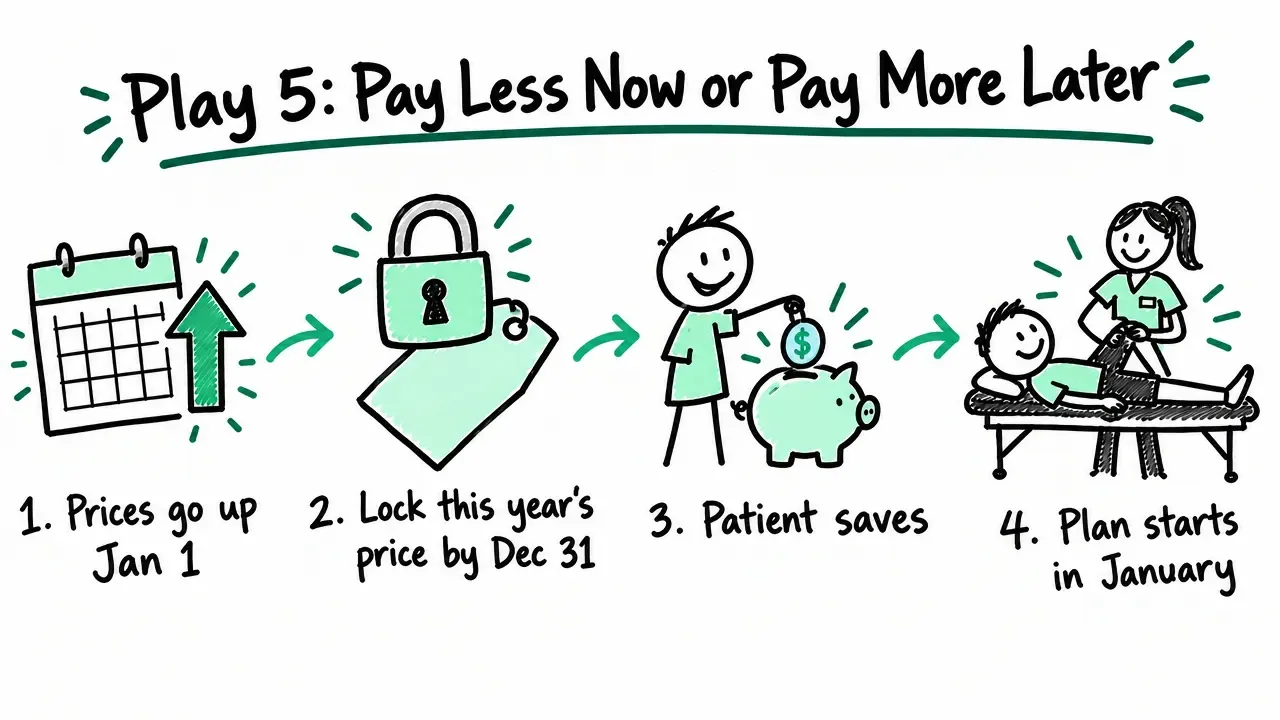
Play 5: How do you run a year-end price lock without feeling pushy?
The idea
You give the customer two honest choices, where they can buy now at a lower price or wait and pay a higher price later.
What it looks like in a PT clinic
If you are planning to raise your cash rates in the new year, you tell your active patients and open leads in December: "My prices go up on January 1. Buy your plan of care by December 31 at this year's price." This gives people who have been sitting on the fence a fair reason to commit before the holidays wrap up.
The math
Pulling January package sales into December helps cover your overhead during a month that is slow for many cash clinics. You get the cash in the bank before the year ends, and the patient saves money on care they already planned to buy.
Watch out for
The price increase on January 1 has to be real, because a fake deadline where your rates stay the same in January breaks your patients' trust and violates the Federal Trade Commission's rules on deceptive pricing.
How do you stack these plays from December into January?
If you have the bandwidth to connect these physical therapy marketing ideas together, they form a clean chain from early December through the spring:
- In December, the gift cards from Play 1 and the FSA outreach from Play 3 bring new people into your evaluation room.
- At the evaluation, you present a clear menu of plans with a specific clinical recommendation based on what they need.
- Before December 31, the price lock from Play 5 gives undecided patients and current package buyers from Play 4 a reason to pay before rates go up.
- In January, the attendance challenge from Play 2 gives your new and returning patients a structured 6-week block to start the year.
- After the 6-week challenge finishes, you roll the patients who finished it into a monthly aftercare program to keep them strong (if this is beneficial for the patients).
If you have a small team, pick one play, and the gift card is the one I would start with.
What legal and compliance rules apply to all five holiday plays?
I am a marketer and a former PT, so none of this is legal advice, and you should always check your state practice act and local laws before launching a promotion. Across all five of these plays, a few baseline rules always apply to a cash-based clinic:
- Patients covered by government health plans like Medicare, Medicare Advantage, Medicaid, and TRICARE are excluded from promotional gifts and discounts.
- Every promotional visit and package must be handled as self-pay only, without billing any insurance payer.
- Every stated dollar "value" in your marketing has to match the real regular price you charge at your clinic every day.
- Clinical need must decide every treatment recommendation you make, regardless of what package or challenge you are running.
For a deeper look at federal inducement rules, state gift regulations, and HIPAA guardrails, read the legal section of my giveaway article before you put your holiday offer live.
Putting your December plan into motion
If December is slow for you, you do not have to sit around waiting for January deductibles to reset. An FSA text can go out this week, while the gift card sale takes more setup, about 2 weeks, so I'd start that one now since it gives your best patients an easy way to bring their friends into your clinic. If you want to step back and build a full year-round system after the holidays settle down, you can read my complete guide to physical therapy marketing to see how all the pieces fit together.
If you want help picking the right play for your clinic and setting it up before the holidays, book a call with me and we can work through it together.
References
- Hormozi, A. $100M Leads: How to Get Strangers to Want to Buy Your Stuff. Acquisition.com, 2023.
- Hormozi, A. $100M Money Models: How to Make Money. Acquisition.com, 2025.
- Hormozi, A. "Top 3 Black Friday Strategies." The Game podcast, episode 466, November 24, 2022. https://play.fountain.fm/episode/LM1lSzZFLSYX7E2fGcui
- Shu, S. B., and Gneezy, A. "Procrastination of Enjoyable Experiences." Journal of Marketing Research, 2010.
- Hormozi, A. Short video on the holiday gift card play. YouTube. https://www.youtube.com/shorts/aDKJ2FAh4WE