You already know how to get more physical therapy patients without a physician referral. Every state allows some form of direct access, and you have probably explained that to a patient this week [1]. So the permission question is settled. The schedule gap is something else. People in your town have the exact problem you fix, and they have never heard of you.
Here is the thing. Direct access removed the gatekeeper. It did not create demand. Nobody wakes up looking for "a physical therapist." They wake up with a back that hurts on their golf swing and whoever answers that question first gets the call.
This article covers five levers that earn attention: narrow search, lead magnets, email, niche offers, and free injury screens.
Why don't patients notice your clinic, even when you market direct?
You are competing for attention, not for permission. Your competition is not the clinic across town. It is every gym, chiropractor, YouTube video, urgent care, and hospital system in your zip code, all publishing to the same feed.
Attention goes to the most specific answer, not the closest clinic. Pew Research found that 72% of internet users looked online for health information in the past year, and 77% of them started at a search engine [2]. They arrive with a question, not a category. If your website answers "we offer physical therapy in Springfield," you are answering a question nobody asked.
The clinics that fill their schedules are not louder. They are narrower.
Are physician referrals bad?
No. A referral relationship that sends steady patients is a real asset, and you should keep it.
The problem is dependence, not the referral itself. You do not control the volume, the timing, or the payer mix of another provider's office. When their front desk changes staff, your Tuesday empties. When their group signs a health system contract, your pipeline reroutes without a phone call.
Direct channels sit alongside referrals. They do not replace them. The goal is a second faucet you own, so one slow month at a referring practice does not become a slow quarter at yours. Self-referred episodes also hold up on outcomes: a review of 62,707 outpatient episodes found self-referred patients used fewer visits and lower total cost than physician-referred patients [3], and a systematic review reached similar conclusions on cost and outcomes [4]. You are not asking patients to accept a worse path.
What should you rank for instead of "physical therapy near me"?
Rank for the intersection of a problem and a person.
You will not beat the hospital system on "physical therapy near me." They have a domain twenty years older than yours and a marketing budget larger than your revenue. Chasing that term burns a year and returns nothing.
Own the specific question instead:
"Low back pain during golf swing" instead of "back pain treatment"
"Hip pain when running downhill" instead of "hip pain physical therapy"
"Pelvic floor pain after C-section" instead of "pelvic floor therapy"
Lower search volume but far higher intent. The person typing that sentence has already decided something is wrong and is looking for someone who understands it. They are not comparison shopping a category. They are looking for a match.
This is also how AI answers work. A narrow question has one good answer, and answer engines quote the page that gives it cleanly. A broad question has fifty passable answers, and you will not be the one it picks. The mechanics of writing for both surfaces are in Private Practice SEO: How Cash-Based Clinics Get Found on Google and in AI Search, and the answer-engine side specifically in What Is Answer Engine Optimization?.
Start with one condition and one population. Write the page that actually answers it. Then write the next one.
How do you turn a visitor into a name you own?
With a lead magnet that matches the page they landed on.
Most people who find your site are not ready to book today. If you have no way to capture them, you paid for that visit and got nothing. "Join our newsletter" captures nobody, because it promises nothing.
A lead magnet that works follows three rules:
One niche per magnet. "5-minute warm-up for golfers with low back pain" gets the golfer. A general mobility guide gets nobody in particular.
One problem, solved. Not a 40-page ebook. One thing they can do tonight.
Instant delivery, on the matching page. The golf magnet sits on the golf page. Not on a separate "free resources" tab nobody visits.
Three formats that consistently earn an email address:
The self-screen. "3 tests to tell whether your hip pain is the joint or the tendon." It gives them a partial answer and makes the full one worth booking.
The guide. A short, specific protocol for the first two weeks of a common problem.
The checklist. "What to ask before you accept a spine surgery consult." Fast to make, high perceived value.
What does email marketing actually do for a PT clinic?
It keeps you in front of people during the weeks they are not ready, so you are still there the week they are.
That gap is the whole reason email matters. Someone downloads your golf guide in March and tweaks the same back in June. If you sent nothing in between, they search again and find somebody else. Across industries, email still reports the highest return of any channel, roughly $36 for every dollar spent in Litmus survey data [5]. Results vary, and a clinic list is not a retail list, but the direction is consistent.
Keep it simple:
Cadence: 1-2x monthly. Consistent beats frequent. A daily email you abandon in week three is worse than nothing.
Structure: one problem, one fix, one soft ask. Three paragraphs is fine.
Best list on your server: past patients. They already trust you and already paid you. A reactivation email costs nothing to send and books faster than any ad you will ever run.
Most clinic owners skip reactivation because it feels like bothering people. It is not. A patient you discharged eight months ago with a new ache is going to see somebody. Make it easy for that somebody to be you.
What offer gets a stranger to book?
An offer built for the niche, not a discount on your rate.
There is a real difference between the two. Cutting your price teaches people your work is negotiable. A specific free screen teaches them you understand their problem. Same cost to you. Opposite message.
Examples that convert:
A free 15-minute golf swing screen for a local club
A runner's gait assessment during marathon training season
A return-to-lifting screen for a CrossFit gym
Whatever you offer, the screen has to do three things: find one thing, tell them one thing, and book the next step while they are still standing in front of you. A screen that ends with "here is my card" is a screen that ends. More on building the offer itself is in Why Your PT Clinic Needs an Offer (Not Just Sessions).
How do you reach people who are not searching yet?
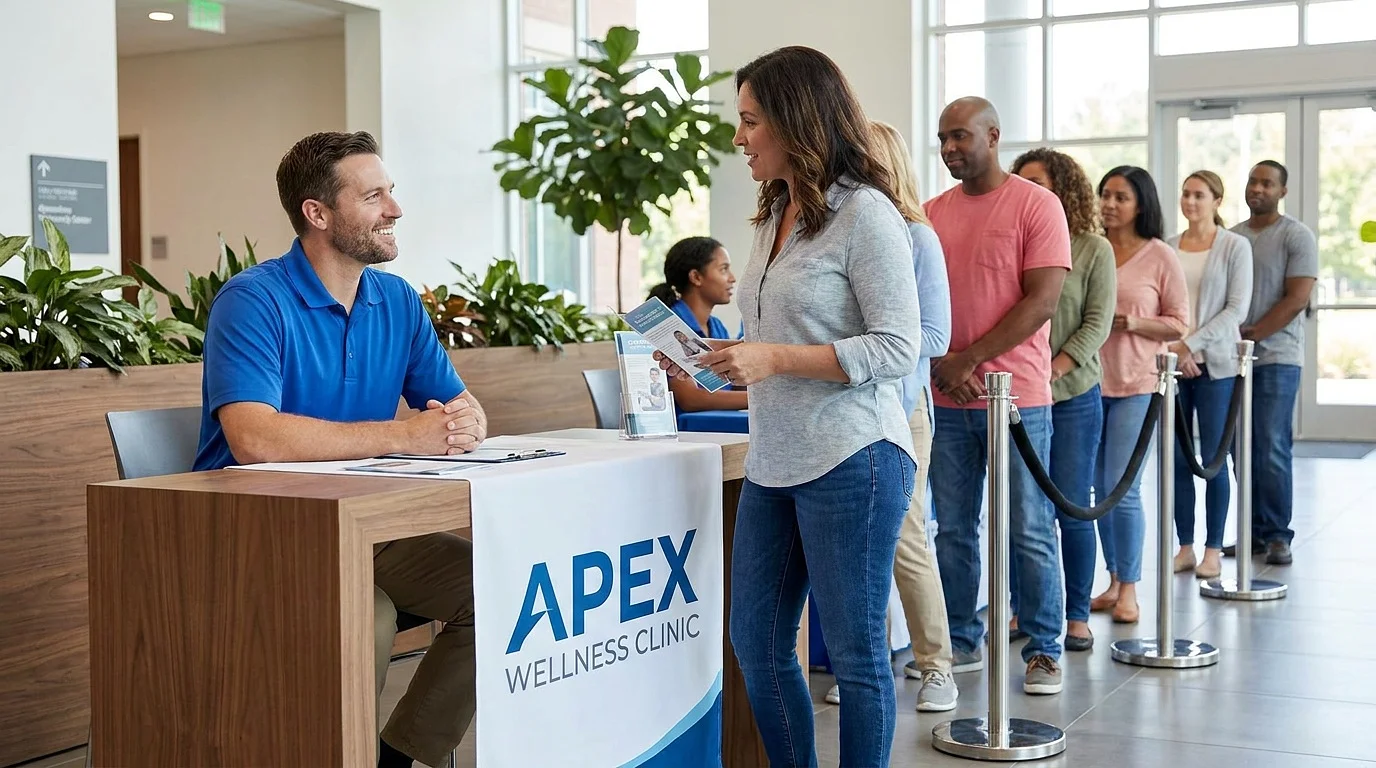
Go where they already are. Free injury screens in public are the fastest channel you have.
SEO compounds, but it compounds slowly. Public screens work this month. Places that consistently produce:
Local races and run clubs
CrossFit boxes and strength gyms
Golf clubs and driving ranges
Employers with physical work, and their safety committees
Bring a mat, a table, a way to take contact information, and a booking link on your phone. That last one matters most. Book the appointment on the spot instead of handing out cards. A card is a task you assigned to a stranger, and strangers do not do homework.
Send a same-day follow-up email while they still remember your face: what you found, what to do this week, and a link to book. That email converts far better than anything you send a week later.
How do the five pieces work together?
They form one loop, and the loop is the point.
Search or a public event finds them. The lead magnet captures the name. Email holds attention through the weeks they are not ready. The niche offer converts them when they are. Each piece is mediocre alone and compounding together.
Run it for one niche first. Pick the population you most want on your schedule, build the page, the magnet, the email, and the screen for that one group, and get it filling. Add the second niche after the first works. Trying to run five at once is how clinic owners end up with five half-built funnels and the same open Tuesday.
For the full channel-by-channel picture, see the Physical Therapy Marketing: The Complete 2026 Guide.
Frequently asked questions
How long does it take to get more patients without referrals?
Public screens can book patients the same week. Lead magnets and email start producing within a month or two of consistent sending. Narrow SEO pages typically take three to six months to rank and longer to compound. Start with the fast channel and let the slow one build under it.
Do free injury screens attract people who will never pay?
Some, yes. That is the cost of the channel, and it is low. Screen at venues where people already spend money on their bodies, gyms, clubs, and races, and the mix improves fast.
How many patients should one niche produce?
Enough to justify the second one. A single well-built niche should reliably fill a recurring block on your schedule. If it cannot do that after a few months of consistent work, the niche is too small or the offer is wrong before the channel is.
Should I run ads instead?
Ads work, and they rent attention rather than build it. Ads amplify a page and an offer that already convert. If the page does not convert organic visitors, paid traffic will fail more expensively.
Do I have to pick a niche to make this work?
Practically, yes. Specificity is the entire mechanism. You can treat everyone who walks in and still market to one group at a time.
How to get more physical therapy patients: where to start this week
Pick one population. Write the one page that answers their specific question, put a matching lead magnet on it, and book one public screen with a gym or club that already serves them. That is a week of work, and it starts the loop.
The clinics that fill without referrals are not doing more marketing. They are doing narrower marketing, for one group at a time, and letting it compound.
If you want a second opinion on which niche to start with, book a free strategy call and we will look at your data together.
References
American Physical Therapy Association. State of Direct Access to Physical Therapist Services. 2025. https://www.apta.org/apta-and-you/news-publications/reports/2025/state-of-direct-access-to-physical-therapist-services
Pew Research Center. Health Online 2013: Majority of Adults Look Online for Health Information. 2013. https://www.pewresearch.org/short-reads/2013/02/01/majority-of-adults-look-online-for-health-information/
Pendergast J, Kliethermes SA, Freburger JK, Duffy PA. "A Comparison of Health Care Use for Physician-Referred and Self-Referred Episodes of Outpatient Physical Therapy." Health Services Research, 2012. https://www.sciencedaily.com/releases/2011/10/111013154004.htm
Demont A, Bourmaud A, Kechichian A, Desmeules F. "Effectiveness and Consequences of Direct Access in Physiotherapy: A Systematic Review." Journal of Clinical Medicine, 2023. https://pmc.ncbi.nlm.nih.gov/articles/PMC10531538/
Litmus. The ROI of Email Marketing / State of Email 2025. 2025. https://www.litmus.com/blog/infographic-the-roi-of-email-marketing
This article is general business and marketing guidance for practice owners, not legal, compliance, or clinical advice. Direct access rules vary by state. Results vary by market, niche, and execution.