Cash-based means nobody is feeding you overflow. There is no insurance panel quietly routing patients to your door because you happen to be in network. Every person on your schedule is someone you had to earn.
That changes the math on private practice SEO. Two things now decide whether the patient who needs exactly what you do ever hears your name: where you land on Google, and whether an AI names you when someone asks it who to see.
Both are winnable for a one-location practice, and neither is won the way a hospital system wins it. Here is what the work actually looks like when you are cash-pay: which searches to fight for, which to ignore, what to publish first, and how long before any of it lands on your schedule.
What is private practice SEO, and how is it different from clinic SEO?
Private practice SEO is the work of getting an independent, usually cash-based clinic found by the specific people willing to pay out of pocket for a specific outcome. It differs from general clinic SEO in who you are chasing: insurance-based clinics compete for broad local volume, while a private practice competes for a narrow, high-intent slice of it.
That difference is not cosmetic. It changes which keywords are worth your time.
An in-network clinic can afford to chase volume. Their economics work on throughput, and a chunk of their schedule arrives through referral relationships whether or not their website does anything. Generic terms like "physical therapy near me" are fine targets for them, and those terms are locked up by hospital systems with decades of domain authority.
You do not have that runway, and you do not need it. Your patient is not searching for physical therapy in general. They are searching for the thing that is wrong with them, often after they already tried the in-network route and it did not work.
Here is the thing: that search is longer, less competitive, and worth dramatically more per visitor. Someone typing "why does my shoulder still hurt after 6 weeks of PT" is pre-qualified in a way that "physical therapy near me" never will be. They have a problem, they have context, and they have already shown they will keep looking.
Narrower intent. Higher value per visitor. Completely different keyword math.
Why does AI search matter for a cash-based practice right now?
It matters because a large share of your prospective patients are now asking an AI for a recommendation instead of scrolling a results page, and that share moved faster in the last year than almost any behavior change in search history.
In BrightLocal's 2026 Local Consumer Review Survey, 45% of consumers said they used AI to find a local business recommendation in the past 12 months. The year before, that number was 6% [1]. ChatGPT led at 31% of consumers, with Google's AI Mode at 23% [1].
Meanwhile the results page itself is giving up fewer clicks. SparkToro's 2026 analysis of Similarweb clickstream data found 68.01% of US Google searches ended without a click in the first four months of 2026, up from 60.45% in 2024 [2].
Put those together and the picture is uncomfortable but clear. More people are asking a machine who to see, and fewer of the people who do search are clicking through to anyone's website.
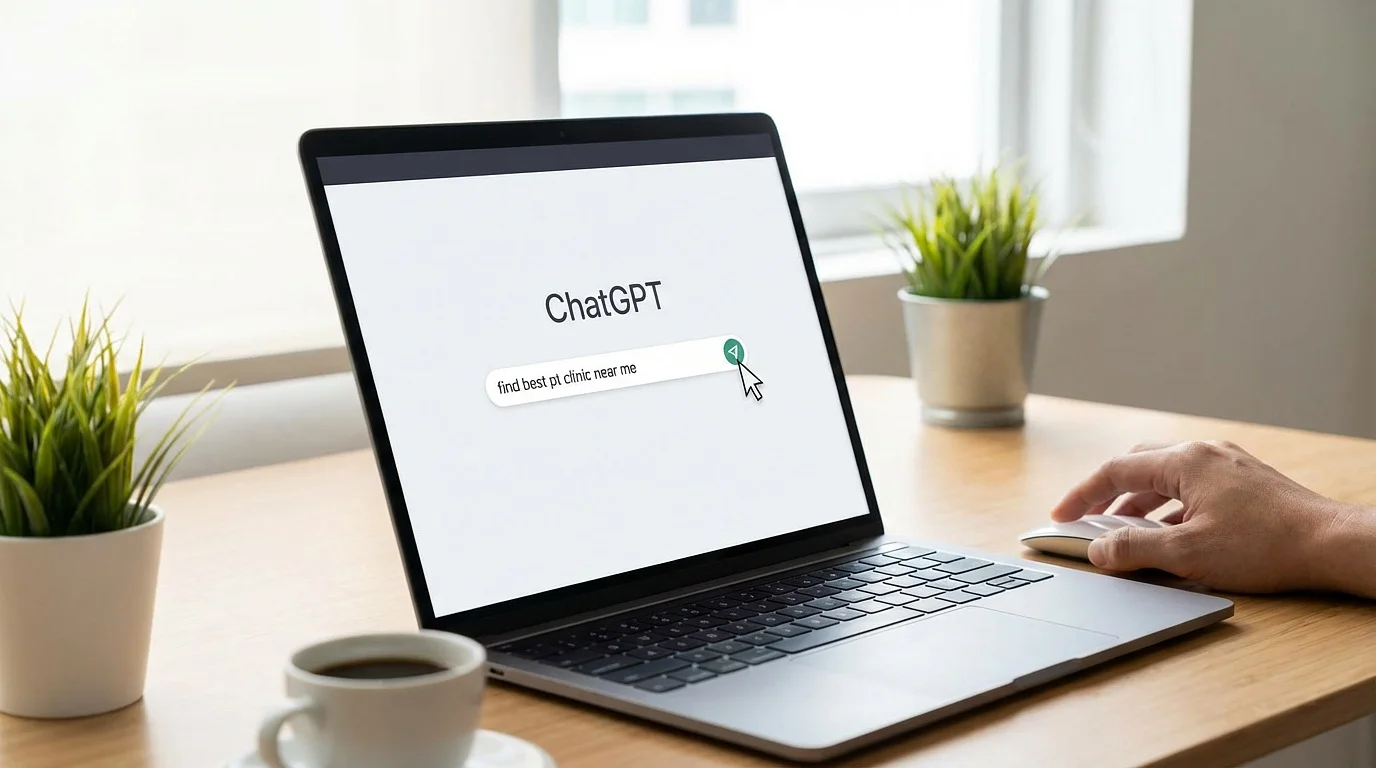
Now here is the part that should get your attention. The patient who will pay out of pocket for a full 60 minute session is, almost by definition, a researcher. They compare, they read, they ask follow-up questions. That is exactly the person who opens ChatGPT and types "best cash-based physical therapist for runners near me" instead of clicking the first three map results.
Your highest-value patient is the one most likely to find you through an answer engine. Or not find you.
How do AI engines actually decide which practices to cite?
Not the way most people assume. Ranking well on Google helps, but it is not the gate.
Semrush's research found ChatGPT cited pages ranking in traditional positions 21 or worse almost 90% of the time [3]. The overwhelming majority of what ChatGPT quotes is not sitting on page one of Google. A well-structured page that answers a specific question can get pulled into an AI answer while ranking nowhere in particular.
That is the most encouraging fact in this article for a small practice.
So what does correlate? Ahrefs studied 75,000 brands across ChatGPT, Google AI Mode, and AI Overviews and found the strongest single predictor of AI visibility was YouTube mentions, at a Spearman correlation of roughly 0.737 [4]. Branded web mentions came next at 0.66 to 0.71. Domain rating, the metric most agencies sell you on, landed between 0.266 and 0.326. Backlinks correlated weakly [4].
In plain terms: being talked about beats being linked to, and being on video beats both.
Google's own guidance quietly kills a lot of expensive advice. Google states that optimizing for generative AI search "is optimizing for the search experience, and thus still SEO," and that "structured data isn't required for generative AI search, and there's no special schema.org markup you need to add" [5].
What Google does emphasize is originality. Its guidance warns against content that recycles "what others on the internet have already said, or could easily be produced by a generative AI model," and separates commodity content from content that "provides unique expert or experienced takes that go beyond common knowledge" [5].
You are a practicing clinician. Unique expert takes that go beyond common knowledge are the one thing you have in unlimited supply and your competitors cannot fake.
What should a cash-based clinic fix first?
In this order. Do not skip ahead.
- Condition pages, one per problem you actually get paid to treat. Not a services list. A real page per problem, named the way patients say it, not the way your documentation says it. "Hip pain when running" beats "gluteal tendinopathy management." Three deep pages beat thirty thin ones.
- The money page. Write the page that says what a session costs, what a typical plan of care runs, and why you chose to work outside insurance. Insurance-based clinics structurally cannot write this page. You can, and it is the single highest-value piece of citation bait you own, because "how much does cash-based physical therapy cost" is exactly the kind of question answer engines want a clean source for.
- Your Google Business Profile. For local intent it is still doing more work than your website, and most clinics treat it as a set-and-forget listing. We covered the specific gaps in Google Business Profile for Physical Therapists.
- Reviews, without violating anyone's privacy. Volume and recency both matter, and pelvic health, mental health, and similar practices need a system that respects what patients will and will not put their name to. That system exists: see How to Get Google Reviews When Your Patients Value Privacy.
- The booking path. Everything above is wasted if the person who finally lands on your site cannot book in under a minute. Physical Therapy Website Design That Books Patients covers what actually converts.
How do you write pages an AI engine will quote?
Lead with the answer, structure around real questions, and be specific enough that nobody else could have written it.
Concretely:
- Open every page with a direct 40 to 60 word answer to the question the page is named after. Put it above the fold, before the story, before the credentials. That block is what gets extracted.
- Make your H2s the exact questions patients type. Not "Our Approach." Try "How long does it take to fix runner's knee?"
- One complete idea per section. An engine pulling a passage needs that passage to stand on its own.
- Use real numbers and named conditions. Session lengths, typical timelines, actual price ranges, specific diagnoses.
- Cite your sources and add an FAQ block near the end.
There is a strategic layer above the tactics, and it is the one most clinics miss. Semrush tracked 50,000 brands across 1,094 US categories over six months in 2026 and found AI visibility is won at the topic level, not the site level. Only 15.2% of categories had a clear owner, and 53.6% were completely unsettled with no dominant brand [6]. Site-wide authority signals barely predicted who won: category owners had higher organic traffic in just 48.4% of head-to-head comparisons [6].
That means the game is not "become the most authoritative PT site in America." It is "own three topics nobody has claimed yet." For a single-location cash practice, that is a fight you can genuinely win, and more than half the categories are still open.
If AI visibility is new territory for you, start with What Is Answer Engine Optimization? and then Why Your PT Clinic Isn't Showing Up in ChatGPT.
What does getting found actually look like in numbers?
Slower than you want, and it shows up in a specific order.
Impressions move first. You will see your pages appearing for more searches weeks before anyone clicks. That is not a failure state, that is the leading indicator working exactly as designed.
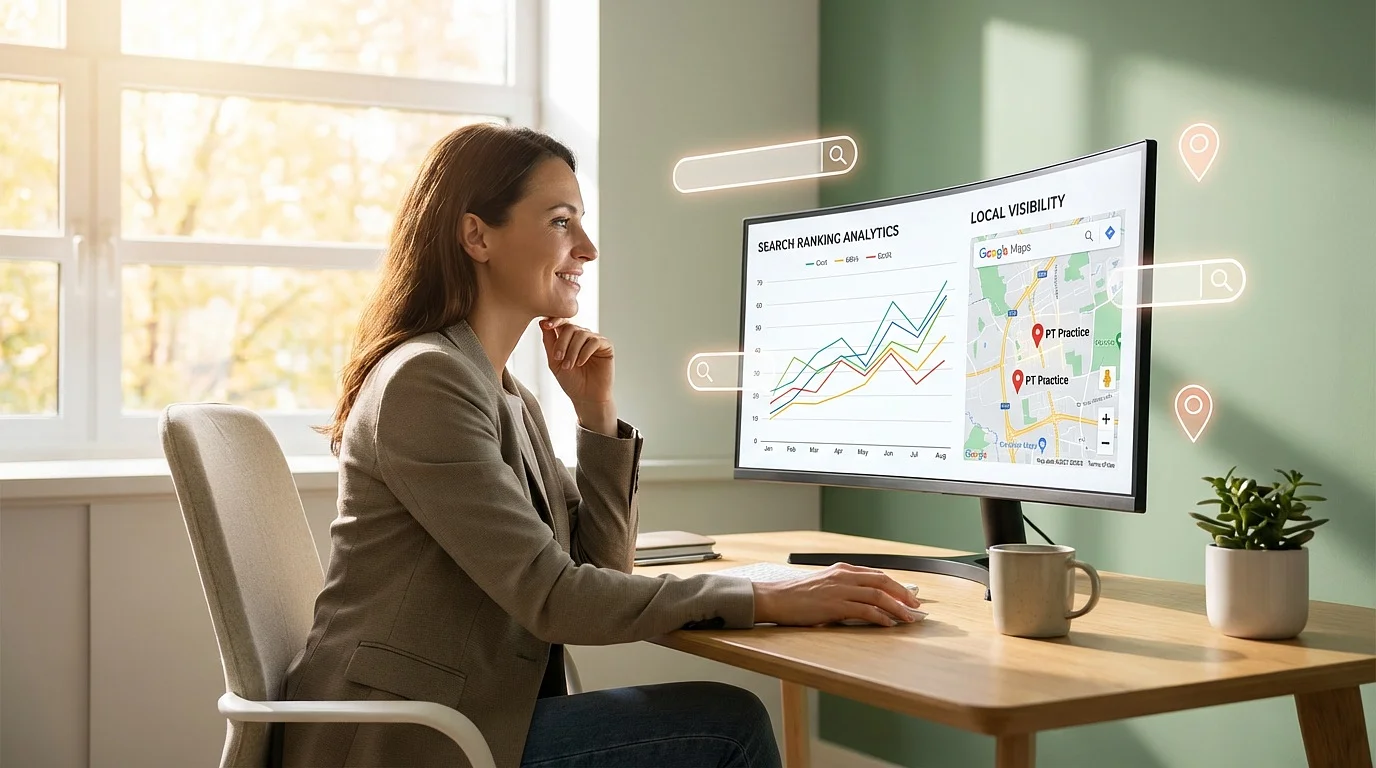
Page-1 footprint is the number to watch: how many distinct searches you appear on the first page for. It climbs before traffic does, and it is far more honest than tracking one vanity keyword.
There is also a middle state in AI search nobody talks about. Your practice can be present in an answer without being cited: the engine is discussing your topic and pulling from someone else's page. You are in the consideration set and not yet named. That is measurable, normal, and the step immediately before getting cited.
Honest timeline: three to six months of consistent publishing before things start compounding. Anyone promising faster is selling you something. For what a healthy click-through rate actually looks like once you do rank, see Physical Therapy SEO: What's Actually a Good Click-Through Rate.
What private practice SEO mistakes cost cash clinics the most?
- Chasing head terms you cannot win. "Physical therapy near me" is owned by hospital systems. Every hour spent there is an hour not spent on the long-tail question your ideal patient is actually typing.
- A homepage that says you treat everyone. It reads as safe. It reads to a cash-pay patient as generic, which is the one thing they are paying extra to avoid.
- Hiding your pricing. The most common and most expensive self-inflicted wound. It costs you the citation, and it costs you the patient who assumed the worst and never called.
- Thin, AI-spun blog posts. This is precisely the commodity content Google's guidance says gets passed over [5]. Ten mediocre posts do less than one page only you could have written.
- Zero video presence. YouTube mentions were the strongest AI-visibility correlation in the Ahrefs data [4], and most clinics have nothing.
- Treating your Google Business Profile as a listing instead of a channel.
Private practice SEO FAQ
How long does private practice SEO take to work?
Expect three to six months before results compound, with impressions moving well before clicks. Condition pages and a pricing page tend to move fastest because they target specific, low-competition intent.
Is SEO worth it for a cash-based practice with one location?
Yes, and arguably more than for an in-network clinic. You need fewer patients at a higher value each, so a handful of pages ranking for the right narrow searches can meaningfully change your schedule.
Do I need schema markup to show up in AI Overviews?
No. Google states directly that structured data is not required for generative AI search and there is no special schema.org markup to add [5]. Clear structure and genuinely original content matter more.
Should I hire an agency or handle it in-house?
Either can work. The deciding factor is usually whether you will consistently publish. If you will, in-house with light support is efficient. If you will not, an agency is worth it. Our guide on what to look for in a physical therapy SEO company covers the questions to ask.
Does ranking #1 on Google guarantee ChatGPT will cite me?
No. Semrush found ChatGPT cited pages ranking in position 21 or worse almost 90% of the time [3]. Traditional rank helps, but structure and clarity carry more weight than raw position.
Where to start this month
Pick the three conditions you most want filling your schedule and write one real page for each. Publish your pricing. Update your Google Business Profile and get a review system running. Answer questions directly, in the words your patients use, with numbers only you have.
That is the whole plan. It is not fast, it is not complicated, and more than half the topic categories in AI search are still sitting unclaimed [6]. The practices that start publishing now are the ones getting named eighteen months from now.
If you want a second set of eyes on where your practice stands, book a free strategy call.
References
- BrightLocal. Local Consumer Review Survey 2026: Half of Consumers Are Asking AI for Business Recommendations. https://www.brightlocal.com/research/lcrs-ai-trust/
- SparkToro, reported by Search Engine Land. Google zero-click searches reach 68% in early 2026: Study. https://searchengineland.com/google-zero-click-searches-2026-study-479717
- Semrush. How to Optimize for AI Search Results in 2026. https://www.semrush.com/blog/ai-search-optimization/
- Ahrefs, reported by TNW. YouTube mentions are the top signal for AI brand visibility (75,000-brand study). https://thenextweb.com/news/ahrefs-youtube-mentions-ai-visibility-brand-search
- Google Search Central. Optimizing your website for generative AI features on Google Search. https://developers.google.com/search/docs/fundamentals/ai-optimization-guide
- Semrush. AI Visibility Is a Topic-Level Game: A Study of 50,000 Brands in ChatGPT. https://www.semrush.com/blog/chatgpt-topic-authority-study/
This article is general business and marketing guidance, not legal, financial, or compliance advice. Results vary by market, practice, and execution.