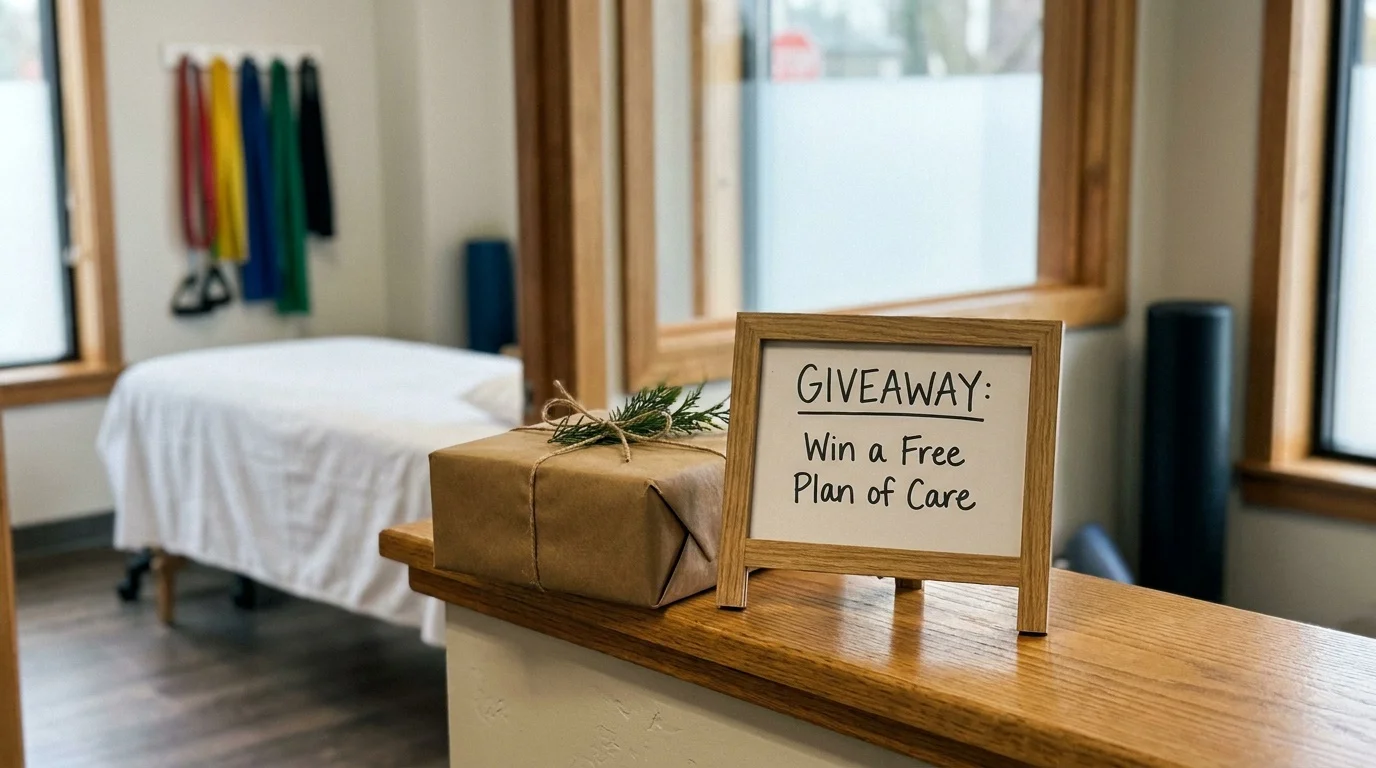
I don't see many PT clinics running giveaways, which is a shame, because even a simple "enter to win a free evaluation" post would get you further than not running one at all. A physical therapy giveaway is one of the easier ways I know to get a whole group of new people raising their hand in the same week. When you set it up well, the person who wins the prize ends up being the smallest part of what you get out of it.
The real value is everyone else who entered. Each of those people just gave you their name, a way to reach them, and a description of what's bothering them, and that's a list you didn't have the week before. If you have a plan for following up with them, a good number of them can turn into patients.
The holiday season is a natural time to try one, since people are already expecting deals, but you can run a giveaway any time you have a reason to celebrate. Below I'll walk through the whole setup, including when to run it, how to pick a prize people actually want, the different ways to structure the offer, what to ask on the entry form, how to follow up, what the math looks like, and the legal rules you'll want to check before you launch.
What is a PT clinic giveaway, and why does it work?
A PT clinic giveaway trades a chance at a big prize for a person's contact information and answers to a few questions about them. One person wins the grand prize, and everyone else who entered gets a promotional offer with a deadline. Most of your new patients will come from that promotional offer rather than from the prize itself.
The structure I'm using here comes from Alex Hormozi's $100M Money Models, where the giveaway is one of what he calls attraction offers, meaning offers designed to bring new people in the door [1]. If you've read my article on why your PT clinic needs an offer, not just sessions, a giveaway fits right on top of that idea. It works best when the prize is a real offer with the value of each piece laid out, so people can see exactly what they'd be winning.
The reason it works so well for a PT clinic is that it lowers the bar for someone to raise their hand. A person with knee pain that's been nagging them for months probably isn't ready to book an evaluation today, but they'll happily spend a minute or two entering to win one. Now you know who they are, what's going on with their knee, and that they're open to hearing from you.
When should you run a giveaway?
Any time you have a real reason to celebrate works, since the reason is what makes the giveaway feel natural instead of random. A few that fit well:
The holidays: Black Friday, Christmas, and the end of the year. People expect deals that time of year, and a lot of them have FSA money that expires on December 31.
Your clinic anniversary: turning three or five or ten is a great excuse to give something back to the community that got you there.
Any holiday that fits your patients: New Year's resolutions, Mother's Day for a pelvic health practice, Father's Day, Valentine's Day, or Halloween.
The seasons: spring sports, summer, the start of fall, or the start of golf season or race season.
A launch: a new service, a new location, or a new therapist joining the team.
I wouldn't run one every month, since part of what makes a giveaway work is that it feels like an event. Somewhere around two to four a year is plenty for most practices.
How do you pick a grand prize that gets entries?
The prize decides more about how your giveaway goes than anything else, so it's worth spending some real time on it.
Give away something you actually sell. A generic prize like an iPad or a gift card brings in people who want an iPad. A prize that's your service brings in people who want help with the problem you solve, and those are the people you want on your list.
Put a dollar value on the prize, every time. This is the most common miss I see when clinics do run giveaways. "Win a free dry needling session" doesn't mean much to someone who has never paid for one, while "win a $175 dry needling session" does. Use the real value of what you're giving, which isn't always the same as what you happen to charge per visit right now, especially if the prize includes extras like a home program or a video library.
Go bigger than feels comfortable. Hormozi's take is that if a giveaway doesn't work, the prize wasn't big enough [1]. I'd guess this is where a lot of PT giveaways fall short, since it's natural to pick the smallest prize you can and hope for the best.
Here's a range of grand prizes to think about, from small to big:
A free evaluation: around $200 in value.
An evaluation plus three visits: around $700.
A full plan of care, like an evaluation plus five visits: around $1,000.
A full program with bonuses: like the 90-day golf program from the offer article, which has a total value of $3,635.
Use a giveaway to test an offer
This is honestly one of my favorite ways to use a giveaway. Maybe you've been thinking about building a real program, like a "90-Day Low Back Program for Golfers," but you've been hesitant to launch it because you're not sure people will pay for it. You might still be selling visits one at a time, or a package that's really just four visits at a small discount.
Giving the program away first is a low-risk way to find out. When you build a program as an offer, the value is already laid out, with the visits, the bonuses, and the dollar value of each piece, so every person who enters sees the full value before they ever see a price. Then the promotional offer tells you whether real people will pay for it. If 50 people enter and six of them buy the program at a discount, you've tested your offer with real money instead of guessing.
Your prize doesn't have to be physical therapy
The prize also doesn't have to be a treatment visit. A lot of clinics already offer, or want to offer, services that aren't billed to insurance, like one-on-one coaching, strength or performance training, small group classes, a running program, or a workshop or online course. A giveaway is a great time to put those in front of people.
This works especially well if you're an insurance-based clinic that's trying to build out a cash-based side of the business. The prize gets people familiar with a service they may not have known you offered, and the promotional offer gives them a reason to try it. The legal section below still applies, since a free service can still count as a gift, but you also don't have to think about how prize visits fit into anyone's insurance plan.
What can you offer the people who don't win?
This is the core of the whole giveaway, since the prize is what gets people to enter and the promotional offer is what turns them into patients. There are a lot of ways to structure it, and here are the ones I'd consider:
The classic: one grand prize, and every other person who entered gets the same prize at a discount, with a deadline.
A discount on a different offer: the winner gets a full plan of care, and everyone else gets 50% off an evaluation.
Tiered prizes: one grand prize, a few runner-up prizes like a free visit each, and a discount for everyone else.
A capped offer: the discount only goes to the first ten people who book, which gives people a real reason to act soon.
Bring a friend: people can name a friend on the entry form, and if they win, the friend wins too. This can roughly double your leads, but please read the legal section first, since a reward for a referral is banned in some states, even for a cash practice.
Nominate someone: people nominate someone they think deserves the prize, and the person nominated wins. You get two leads from every entry, and since the person who nominates doesn't get a reward, it stays much cleaner legally.
The downsell: some people will say no to the promotional offer, and for them you can offer something smaller, like a free 15-minute injury screen. Some of them will take that, and some of those will become patients.
For sizing the discount, Hormozi's rule of thumb is to make it worth 10 to 30% of your gross margin on the offer [1]. As an example, if your margin on a $2,497 program is about $1,500, a discount somewhere between $150 and $450 fits the rule.
The same idea from the prize applies here too, which is to lead with the value and then the price. "Our $3,635 golf program, with $500 off for everyone who entered" lands very differently than "$1,997 for a golf program," and that matters most when you're selling a program or a package rather than single visits.
Partnering with other providers and businesses
Running a giveaway with a partner is one of the best ways to reach people who have never heard of you. Each partner adds something to the prize and shares the giveaway with their own patients, clients, or members, so you get in front of an audience you'd have a hard time reaching on your own. You also end up with the contact information of everyone who entered from their side.
A few pairings that make a lot of sense:
A pelvic health practice with an OB/GYN or midwifery practice, a doula, a lactation consultant, or a prenatal yoga studio.
A sports or orthopedic practice with a local gym, a CrossFit box, a run club, or a running store.
A golf-focused practice with a local course, a golf pro, or a club fitter.
A vestibular or concussion practice with an audiologist, optometrist, or a youth sports league.
The one rule I'd hold firm on is that each partner pays for their own part of the prize, and nobody pays anyone for a patient they send over. That matters even more when your partner is a physician's office, since referral rules between medical providers are strict.
What should you ask for on the entry form?
You can ask for more than you probably think. Someone entering a free giveaway is usually willing to answer more questions than someone filling out a contact form on your website, and that extra information makes your follow-up a lot better.
Contact information: name, email, phone, and a checkbox that gives you permission to contact them.
Eligibility questions: their age, the injury or goal they're dealing with, how long it's been bothering them, and what they've already tried. These help you qualify each lead, and they tell you exactly what to talk about when you follow up.
The government health plan question: "Are you covered by Medicare, Medicaid, TRICARE, or VA health care?" I'll explain why in the legal section.
Qualifying actions (optional): you can ask people to attend a short call, follow your page, or share the giveaway with someone who'd want it.
One thing to know about sharing is that Facebook doesn't allow "share to enter" or "tag a friend to enter" on a Page post [8]. The simplest way around it is to send everyone to a landing page with the entry form. If you want a refresher on what makes a page convert, I covered that in 5 Conversion Killers Hiding on Your PT Clinic's Website.
How long should a giveaway run, and how do you promote it?
Three to seven days is the sweet spot. Hormozi recommends setting the drawing three to seven days after you start promoting [1], because a giveaway that runs for two months just fades into the background, while one that ends on Friday gives people a reason to enter now.
During that window, post an update every day on social media, by email, and by text. The part I'd really encourage you to take advantage of is that each update is also a chance to market your clinic. Rather than just posting "three days left," use each update to show people why the prize is worth winning:
Day 1: what's included in the prize and the dollar value of each piece.
Day 2: a testimonial from a patient who had the same problem the prize solves.
Day 3: what a visit with you actually looks like, or a short video of you explaining the program.
Day 4: a real result you've gotten for someone, with their written permission.
The last day: a reminder that entries close tonight.
I'd also plan an extra push for the last 48 hours, since that's when a lot of people get around to entering, the same way most of us pay a bill on the day it's due.
What happens after the drawing?
Announce the grand prize winner publicly, after you get their written permission. Once someone becomes your patient, their name and photo count as protected health information, so it's worth getting the permission in writing before you post anything. I go over how to ask in a way that feels comfortable in How to Get Google Reviews When Your Patients Value Privacy.
Everyone else should hear from you privately with the promotional offer, ideally in a personal text or email rather than a mass blast. Something like this works well:
"Hi Sarah, thanks so much for entering the giveaway. You didn't win the grand prize this time, but I read your answers and I'd love to help with that knee. Everyone who entered gets $100 off an evaluation through November 13, so just reply here and I'll get you on the schedule."
Make sure the promotional offer has its own deadline too, usually one to two weeks out. Without one, people fully intend to book and then life gets in the way. For anyone who says no, you can follow up with the downsell, something like "No problem at all. If you'd like, I'm happy to do a free 15-minute screen so you at least know what's going on."
Hormozi also suggests telling the people who didn't win that you were impressed by their answers [1], which is great as long as it's true. The thing I'd avoid is telling anyone they were "specially selected" or a "runner-up" when everyone who entered is getting the same offer, since some states, including Iowa, ban that kind of wording [4]. "Everyone who entered gets $100 off" is honest, and it still works.
Is a giveaway worth it? The math
In most cases, one new patient pays for the whole giveaway. I know giving away a full plan of care can feel like a lot, so here are the numbers with some simple assumptions:
Lifetime value of a patient: $1,000.
The grand prize: a full plan of care, valued at about $1,000.
Entries: 50.
The promotional offer: 50% off a $200 evaluation, so $100 off.
The real cost of the prize is your time. If you have open slots on your schedule, the actual cost is close to nothing. If you're fully booked, it could cost you up to $1,000 in other visits, so the table below uses that worst case.
People who book | New patients | Lifetime value | Prize cost | Discounts | Net |
|---|---|---|---|---|---|
10% | 5 | $5,000 | $1,000 | $500 | about +$3,500 |
20% | 10 | $10,000 | $1,000 | $1,000 | about +$8,000 |
30% | 15 | $15,000 | $1,000 | $1,500 | about +$12,500 |
You break even at about 1.1 new patients, so even a giveaway that does worse than the first row still comes out ahead.
These booking rates are examples rather than benchmarks. I haven't found a reliable published number for how many giveaway entrants become patients, and it'll depend a lot on your prize, your offer, and how well you follow up. The shape of the math holds up either way, with a small downside and a big upside.
The part the table leaves out: your email list
The biggest thing the table doesn't count is the list itself. You now have 50 people in your area who told you exactly what's bothering them and said it's okay to contact them. Plenty of them won't be ready to book this month, whether it's timing or money or just life, and that's fine, because they're still on your list.
If you send a monthly newsletter, those 50 people hear from you twelve more times over the next year, and every one of those emails is a reminder that you can help with the problem they already told you about. Someone who enters a holiday giveaway with shoulder pain may well book in March when it flares up again, and they'll book with you because you're the clinic that's been in their inbox. If you don't have a newsletter yet, a giveaway is a great reason to start one. For more ways to stay in front of people, see How to Get More Physical Therapy Patients to Notice You.
What are the legal rules for a PT giveaway?
I want to be upfront that this isn't legal advice, and the rules really do vary from state to state. Before you launch, check your state's sweepstakes laws, your state's physical therapy practice act, and your PT board's rules, and if you can, spend an hour with a healthcare attorney. That hour is cheap compared to getting it wrong.
Here's what I'd look at:
No purchase necessary. A prize, combined with chance and a required payment, can turn a giveaway into an illegal lottery. Put "No purchase necessary" on the entry page, and never make a paid visit the way someone enters.
Government health plans. Federal rules limit gifts to Medicare and Medicaid patients to $15 per item and $75 per year [2], and a $1,000 plan of care is well over that. The safest approach is to exclude people covered by Medicare, Medicaid, TRICARE, and VA health care in your official rules, and to confirm the winner's coverage before you give the prize.
Referral rewards. Rewarding someone for sending you a patient can violate the federal Anti-Kickback Statute if you bill federal programs [3], and some states go further. California bans any reward for a referral, even in a cash practice [5]. Check your state before you use the "bring a friend" option. The "nominate someone" option, where the person who nominates gets nothing, avoids the problem.
Don't bill insurance for prize visits. The visits are free, so there's nothing to bill.
Bigger prize pools. If your total prizes are worth more than $5,000, New York and Florida require you to register the giveaway and post a bond [6][7].
Taxes. A prize counts as income for the winner. For prizes given in 2026, you send a 1099-MISC if the prize is worth $2,000 or more, which went up from $600 in 2025 [9]. Again, check with an actual accountant on this - this article is strictly for educational purposes not financial advice.
Official rules. Write down the dates, who can enter, the prize and its value, how you'll pick the winner, and your exclusions, then link to them from the entry page.
Facebook and Instagram rules. No "share to enter" and no "tag a friend to enter" [8].
None of this should scare you off from running a giveaway. It mostly means planning an extra hour of setup so everything is clean before you launch.
PT giveaway FAQ
What is a good prize for a physical therapy giveaway?
Something you actually sell, with a clear dollar value attached. A full plan of care or a program with bonuses will get a lot more entries than a single free visit. If your giveaway doesn't get many entries, I'd make the prize bigger before changing anything else.
How many entries should I expect?
It depends on the size of your email list, your social following, and your prize. A local clinic with a modest following might see somewhere around 30 to 100 entries, and partnering with another business can multiply that, since every partner shares it with their own audience.
Can I give away free physical therapy if I take insurance?
Often you can, with some care. Exclude people on Medicare, Medicaid, TRICARE, and VA health care, don't bill insurance for the prize visits, and avoid rewards for referrals. Giving away a cash service like coaching or a class is another good option. Either way, check your state's rules and talk to a healthcare attorney before you launch.
How long should a giveaway run?
Three to seven days for entries, and then one to two weeks for people to use the promotional offer.
What do I say to the people who didn't win?
Thank them, show them you actually read their answers, and give them the offer with a clear deadline. Be honest that everyone who entered is getting the offer, rather than telling them they were specially selected.
Putting it together
If you take one thing from this, I'd make it the three pieces that do most of the work: a big prize with a real dollar value on it, a promotional offer for everyone who doesn't win, and a deadline on both. With those in place, the holiday season, your anniversary, or the first week of spring can turn into one of your best weeks for new patients all year. If you want to see where a giveaway fits alongside everything else, Physical Therapy Marketing: The Complete 2026 Guide covers the bigger picture.
If this sparked some ideas and you'd like to talk through what a giveaway could look like for your clinic, including the prize, the offer, and the follow-up, book a call with me and we can work through it together.
References
Hormozi, A. $100M Money Models: How to Make Money. Acquisition.com, 2025. Section on Giveaway offers.
U.S. Department of Health and Human Services, Office of Inspector General. "Policy Statement Regarding Gifts of Nominal Value to Medicare and Medicaid Beneficiaries." December 2016. https://oig.hhs.gov/documents/special-advisory-bulletins/887/OIG-Policy-Statement-Gifts-of-Nominal-Value.pdf
Federal Anti-Kickback Statute, 42 U.S.C. § 1320a-7b(b). https://www.law.cornell.edu/uscode/text/42/1320a-7b
Iowa Code Chapter 714B, Prize Promotions. https://www.legis.iowa.gov/docs/code/714B.pdf
California Business and Professions Code § 650. https://leginfo.legislature.ca.gov/faces/codes_displaySection.xhtml?lawCode=BPC§ionNum=650
New York General Business Law § 369-e, Games of chance. https://www.nysenate.gov/legislation/laws/GBS/369-E
Florida Statutes § 849.094, Game promotion in connection with sale of consumer products or services. https://www.flsenate.gov/Laws/Statutes/2025/849.094
Meta. "Pages, Groups and Events Policies: Promotions." https://www.facebook.com/policies_center/pages_groups_events
Verrill. "You Might Be a Winner: The New $2,000 Threshold for Sending IRS Form 1099-MISC to Prize Winners." https://www.verrill-law.com/blog/the-new-2000-threshold-for-sending-irs-form-1099-misc-to-prize-winners/
This article is general business information, not legal or tax advice. Laws vary by state and change over time, so talk to a healthcare attorney and a tax professional before you run a giveaway.